


Page 361 - leadership-experience-2008
P. 361
CikguOnline
      CikguOnline
            342                                                               PART 4: THE LEADER AS A RELATIONSHIP BUILDER

                                     Exhibit 11.4 Rank Orderings of 10 Countries Along Four Dimensions of National
                                     Value System

                                     Country         Power a   Uncertainty b  Individualism c  Masculinity d
                                     Australia         7           7              2              5
                                     Costa Rica        8           2 (tie)       10              9
                                     France            3           2 (tie)        4              7
                                     India             2           9              6              6
                                     Japan             5           1              7              1
                                     Mexico            1           4              8              2
                                     Sweden           10          10              3             10
                                     Thailand          4           6              9              8
                                     United States     6           8              1              4
                                         a 1   highest power distance; 10   lowest power distance
                                         b 1   highest uncertainty avoidance; 10   lowest uncertainty avoidance
                                         c 1   highest individualism; 10   highest collectivism
                                         d 1   highest masculinity; 10   highest femininity

                                   Source: From Dorothy Marcic, Organizational Behavior and Cases, 4th ed. (St. Paul, MN: West, 1995).
                                   Based on Geert Hofstede, Culture’s Consequences (London: Sage Publications, 1984); and Cultures and
                                   Organizations: Software of the Mind (New York:McGraw-Hill, 1991).


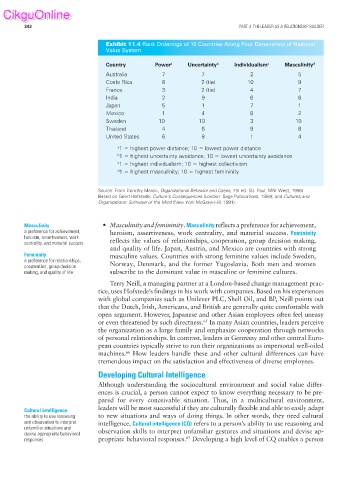
            Masculinity             •  Masculinity and femininity. Masculinity reflects a preference for achievement,
            Masculinity
            a preference for achievement,   heroism, assertiveness, work centrality, and material success.  Femininity
            a preference for achievement,
            heroism, assertiveness, work
            heroism, assertiveness, work
            centrality, and material success
            centrality, and material success  reflects the values of relationships, cooperation, group decision making,
                                       and quality of life. Japan, Austria, and Mexico are countries with strong
            Femininity
            Femininity                 masculine values. Countries with strong feminine values include Sweden,
            a preference for relationships,
            a preference for relationships,
            cooperation, group decision
            cooperation, group decision   Norway, Denmark, and the former Yugoslavia. Both men and women
            making, and quality of life  subscribe to the dominant value in masculine or feminine cultures.
            making, and quality of life
                                       Terry Neill, a managing partner at a London-based change management prac-

                                   tice, uses Hofstede’s findings in his work with companies. Based on his experiences
                                   with global companies such as Unilever PLC, Shell Oil, and BP, Neill points out
                                   that the Dutch, Irish, Americans, and British are generally quite comfortable with
                                   open argument. However, Japanese and other Asian employees often feel uneasy
                                   or even threatened by such directness.  In many Asian countries, leaders perceive
                                                                   65
                                   the organization as a large family and emphasize cooperation through networks
                                   of personal relationships. In contrast, leaders in Germany and other central Euro-
                                   pean countries typically strive to run their organizations as impersonal well-oiled
                                   machines.  How leaders handle these and other cultural differences can have
                                            66
                                   tremendous impact on the satisfaction and effectiveness of diverse employees.
                                   Developing Cultural Intelligence
                                   Although understanding the sociocultural environment and social value differ-
                                   ences is crucial, a person cannot expect to know everything necessary to be pre-
                                   pared for every conceivable situation.  Thus, in a multicultural environment,
                                   leaders will be most successful if they are culturally flexible and able to easily adapt

            Cultural intelligence
            Cultural intelligence
            the ability to use reasoning
            the ability to use reasoning   to new situations and ways of doing things. In other words, they need cultural
            and observation to interpret   intelligence. Cultural intelligence (CQ) refers to a person’s ability to use reasoning and
            and observation to interpret
            unfamiliar situations and
            unfamiliar situations and
            devise appropriate behavioral
            devise appropriate behavioral   observation skills to interpret unfamiliar gestures and situations and devise ap-
                                                              67
            responses
            responses              propriate behavioral responses.  Developing a high level of CQ enables a person

