


Page 387 - leadership-experience-2008
P. 387
CikguOnline
      CikguOnline
            368                                                               PART 4: THE LEADER AS A RELATIONSHIP BUILDER
                                       Scarcity refers to whether the resource is easy or difficult to obtain. A re-

                                   source that is difficult or expensive to acquire is more valuable and creates more

                                   dependency than one that is widely available. In Ireland, for example, an infl ux of
                                   information technology and finance companies over the past 15 years has left top


                                   managers scrambling to find employees with skills and experience in these fi elds.
                                   Irish engineers who once had to come to the United States to get jobs now fi nd
                                   themselves highly valued in their own country, and U.S. technology and fi nance
                                   professionals are learning that companies in Ireland will gladly help them with the
                                   necessary work permits, visas, information on taxes and real estate, and moving
                                                              37
                                   expenses to get them to sign on.  Leaders and employees with specialized knowl-
                                   edge in U.S. firms also serve to illustrate this aspect of dependency. In companies

                                   moving toward e-business, some young Internet-literate managers have gained
                                   power over senior leaders who have no computer expertise.
                                       The third characteristic, nonsubstitutability, means that leaders or employees
                                   with control over resources with no viable substitute will have more power. These
                                   resources may include knowledge and expertise as well as access to people with
                                   high power. For example, an executive secretary that has daily access to the CEO
                                   might have more power than middle managers, who must compete for a few min-
                                   utes of the top leader’s time.

                                   Sources of Leader Power in Organizations

                                   An understanding of dependency and control over resources provides the foun-
                                   dation for examining several sources of leader power in organizations. The fi ve
                                   types of power we discussed earlier are derived from either formal position or the
                                   leader’s personal qualities. These sources provide a basis for much of a leader’s

                                   influence. In organizations, however, additional sources of power and infl uence

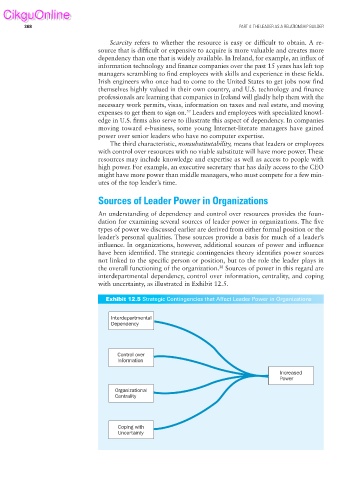
                                   have been identified. The strategic contingencies theory identifi es power sources
                                   not linked to the specifi c person or position, but to the role the leader plays in
                                   the overall functioning of the organization.  Sources of power in this regard are
                                                                        38
                                   interdepartmental dependency, control over information, centrality, and coping
                                   with uncertainty, as illustrated in Exhibit 12.5.
                                     Exhibit 12.5 Strategic Contingencies that Affect Leader Power in Organizations


                                       Interdepartmental
                                       Dependency


                                         Control over
                                         Information
                                                                                           Increased
                                                                                           Power
                                        Organizational
                                        Centrality


                                         Coping with
                                         Uncertainty

