


Page 41 - leadership-experience-2008
P. 41
CikguOnline
      CikguOnline
            22                                                                      PART 1: INTRODUCTION TO LEADERSHIP

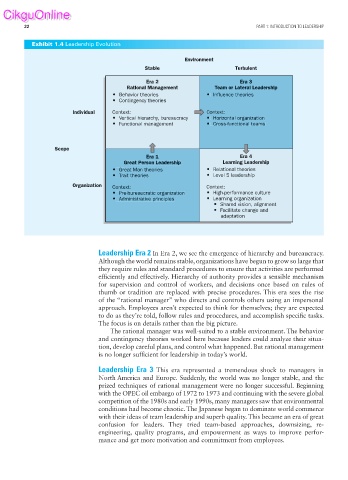
               Exhibit 1.4 Leadership Evolution

                                                              Environment
                                                 Stable                      Turbulent
                                                  Era 2                        Era 3
                                            Rational Management        Team or Lateral Leadership
                                                                       T T
                                       •  Behavior theories         •  Influence theories
                                       •  Contingency theories
                           Individual  Context:                     Context:
                                       • Vertical hierarchy, bureaucracy  •  Horizontal organization
                                       •  Functional management     •  Cross-functional teams


                      Scope
                                                  Era 1                        Era 4
                                           Great Person Leadership       Learning Leadership
                                       •  Great Man theories        •  Relational theories
                                       •  Trait theories            •  Level 5 leadership
                           Organization
                                       Context:                     Context:
                                       •  Pre-bureaucratic organization  •  High-performance culture
                                       •  Administrative principles  •  Learning organization
                                                                       •  Shared vision, alignment
                                                                       •  Facilitate change and
                                                                         adaptation


                                   Leadership Era 2 In Era 2, we see the emergence of hierarchy and bureaucracy.
                                   Although the world remains stable, organizations have begun to grow so large that
                                   they require rules and standard procedures to ensure that activities are performed
                                   effi ciently and effectively. Hierarchy of authority provides a sensible mechanism
                                   for supervision and control of workers, and decisions once based on rules of
                                   thumb or tradition are replaced with precise procedures. This era sees the rise
                                   of the “rational manager” who directs and controls others using an impersonal
                                   approach. Employees aren’t expected to think for themselves; they are expected
                                   to do as they’re told, follow rules and procedures, and accomplish specifi c tasks.
                                   The focus is on details rather than the big picture.
                                       The rational manager was well-suited to a stable environment. The behavior
                                   and contingency theories worked here because leaders could analyze their situa-
                                   tion, develop careful plans, and control what happened. But rational management
                                   is no longer suffi cient for leadership in today’s world.

                                   Leadership Era 3  This era represented a tremendous shock to managers in
                                   North America and Europe. Suddenly, the world was no longer stable, and the
                                   prized techniques of rational management were no longer successful. Beginning
                                   with the OPEC oil embargo of 1972 to 1973 and continuing with the severe global
                                   competition of the 1980s and early 1990s, many managers saw that environmental
                                   conditions had become chaotic. The Japanese began to dominate world commerce
                                   with their ideas of team leadership and superb quality. This became an era of great
                                   confusion for leaders.  They tried team-based approaches, downsizing, re-
                                   engineering,  quality  programs, and empowerment as ways to improve  perfor-
                                   mance and get more motivation and commitment from employees.

