


Page 43 - leadership-experience-2008
P. 43
CikguOnline
      CikguOnline
            24                                                                      PART 1: INTRODUCTION TO LEADERSHIP

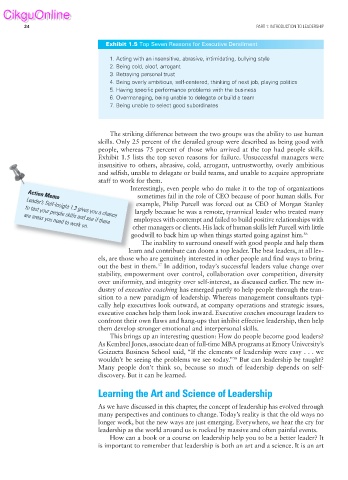
                                     Exhibit 1.5 Top Seven Reasons for Executive Derailment

                                       1. Acting with an insensitive, abrasive, intimidating, bullying style
                                       2. Being cold, aloof, arrogant
                                       3. Betraying personal trust
                                       4. Being overly ambitious, self-centered, thinking of next job, playing politics
                                       5. Having specific performance problems with the business
                                       6. Overmanaging, being unable to delegate or build a team
                                       7. Being unable to select good subordinates


                                       The striking difference between the two groups was the ability to use human
                                   skills. Only 25 percent of the derailed group were described as being good with
                                   people, whereas 75 percent of those who arrived at the top had people skills.
                                   Exhibit 1.5 lists the top seven reasons for failure. Unsuccessful managers were
                                   insensitive to others, abrasive, cold, arrogant, untrustworthy, overly ambitious

                                   and selfish, unable to delegate or build teams, and unable to acquire appropriate
                                   staff to work for them.
                                               terestingly, even people who do make it to the top of organizations
                                               sometimes fail in the role of CEO because of poor human skills. For
             Action Memo
                                               example, Philip Purcell was forced out as CEO of Morgan Stanley
                                              largely because he was a remote, tyrannical leader who treated many
             Leader’s Self-Insight 1.3 gives you a chance
                                               mployees with contempt and failed to build positive relationships with
            to test your people skills and see if there
            are areas you need to work on.
                                               ther managers or clients. His lack of human skills left Purcell with little
                                              oodwill to back him up when things started going against him. 56
                                                The inability to surround oneself with good people and help them
                                            learn and contribute can doom a top leader. The best leaders, at all lev-
                                   els, are those who are genuinely interested in other people and fi nd ways to bring
                                   out the best in them.  In addition, today’s successful leaders value change over
                                                     57
                                   stability, empowerment over control, collaboration over competition, diversity
                                   over uniformity, and integrity over self-interest, as discussed earlier. The new in-
                                                          g
                                   dustry of executive coaching has emerged partly to help people through the tran-
                                   sition to a new paradigm of leadership. Whereas management consultants typi-
                                   cally help executives look outward, at company operations and strategic issues,
                                   executive coaches help them look inward. Executive coaches encourage leaders to
                                   confront their own flaws and hang-ups that inhibit effective leadership, then help

                                   them develop stronger emotional and interpersonal skills.
                                       This brings up an interesting question: How do people become good leaders?
                                   As Kembrel Jones, associate dean of full-time MBA programs at Emory  University’s
                                   Goizueta Business School said, “If the elements of leadership were easy . . . we
                                   wouldn’t be seeing the problems we see today.”  But can leadership be taught?
                                                                             58
                                   Many people don’t think so, because so much of leadership depends on self-
                                   discovery. But it can be learned.

                                   Learning the Art and Science of Leadership

                                   As we have discussed in this chapter, the concept of leadership has evolved through
                                   many perspectives and continues to change. Today’s reality is that the old ways no
                                   longer work, but the new ways are just emerging. Everywhere, we hear the cry for
                                   leadership as the world around us is rocked by massive and often painful events.
                                       How can a book or a course on leadership help you to be a better leader? It
                                   is important to remember that leadership is both an art and a science. It is an art

