


Page 45 - leadership-experience-2008
P. 45
CikguOnline
      CikguOnline
            26                                                                      PART 1: INTRODUCTION TO LEADERSHIP
                                   importance of leadership to an organization’s success, as well as the diffi culties
                                   and challenges involved in being a leader. Studying leadership can also lead to the
                                   discovery of abilities you never knew you had. When students in a leadership sem-
                                   inar at Wharton were asked to pick one leader to represent the class, one woman
                                   was surprised when she outpolled all other students. Her leadership was drawn
                                   out not in the practice of leadership in student government, volunteer activities,
                                   or athletics, but in a classroom setting. 59
                                       Studying leadership gives you skills you can apply in the practice of leadership
                                   in your everyday life. Many people have never tried to be a leader because they
                                   have no understanding of what leaders actually do. The chapters in this book are
                                   designed to help you gain a fi rm knowledge of what leadership means and some
                                   of the skills and qualities that make a good leader. You can build competence in
                                   both the art and the science of leadership by completing the Self-Insight exercises
                                   throughout the book, by working on the activities and cases at the end of each
                                   chapter, and by applying the concepts you learn in class, in your relationships
                                   with others, in student groups, at work, and in voluntary organizations. Although
                                   this book and your instructors can guide you in your development, only you can
                                   apply the concepts and principles of leadership in your daily life. Learning to be a
                                   leader starts now, with you. Are you up to the challenge?

                                   Organization of the Rest of the Book

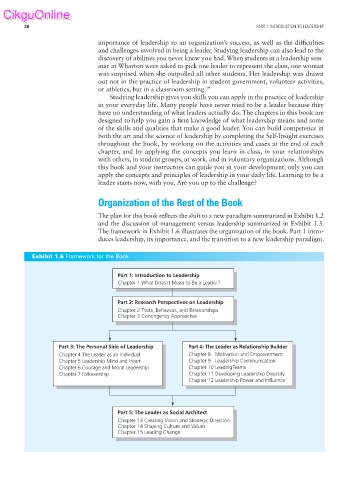
                                   The plan for this book refl ects the shift to a new paradigm summarized in Exhibit 1.2
                                   and the discussion of management versus leadership summarized in  Exhibit 1.3.
                                   The framework in Exhibit 1.6 illustrates the organization of the book. Part 1 intro-
                                   duces leadership, its importance, and the transition to a new leadership paradigm.


               Exhibit 1.6 Framework for the Book


                                         Part 1: Introduction to Leadership
                                         Chapter 1 What Does It Mean to Be a Leader?


                                         Part 2: Research Perspectives on Leadership
                                         Chapter 2 Traits, Behaviors, and Relationships
                                                T
                                                T
                                         Chapter 3 Contingency Approaches


                       Part 3: The Personal Side of Leadership  Part 4: The Leader as Relationship Builder
                       Chapter 4 The Leader as an Individual   Chapter 8   Motivation and Empowerment
                       Chapter 5 Leadership Mind and Heart     Chapter 9   Leadership Communication
                                                                            T
                                                                            T
                       Chapter 6 Courage and Moral Leadership  Chapter 10 LeadingTeams
                       Chapter 7 Followership                  Chapter 11 Developing Leadership Diversity
                                                               Chapter 12 Leadership Power and Influence


                                         Part 5: The Leader as Social Architect
                                         Chapter 13 Creating Vision and Strategic Direction
                                         Chapter 14 Shaping Culture and Values
                                                                V
                                                                V
                                         Chapter 15 Leading Change

