


Page 421 - leadership-experience-2008
P. 421
CikguOnline
      CikguOnline
            402                                                                   PART 5: THE LEADER AS SOCIAL ARCHITECT

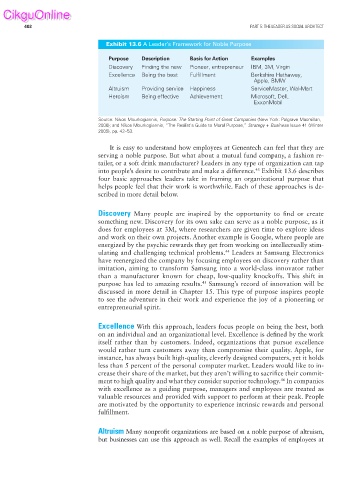
                                     Exhibit 13.6 A Leader’s Framework for Noble Purpose

                                      Purpose   Description    Basis for Action   Examples
                                      Discovery  Finding the new  Pioneer, entrepreneur  IBM, 3M, Virgin
                                      Excellence  Being the best  Fulfillment     Berkshire Hathaway,
                                                                                   Apple, BMW
                                      Altruism  Providing service  Happiness      ServiceMaster, Wal-Mart
                                      Heroism   Being effective  Achievement      Microsoft, Dell,
                                                                                   ExxonMobil


                                   Source: Nikos Mourkogiannis, Purpose: The Starting Point of Great Companies (New York: Palgrave Macmillan,
                                   2006); and Nikos Mourkogiannis, “The Realist’s Guide to Moral Purpose,” Strategy + Business Issue 41 (Winter
                                   2005), pp. 42–53.

                                       It is easy to understand how employees at Genentech can feel that they are
                                   serving a noble purpose. But what about a mutual fund company, a fashion re-
                                   tailer, or a soft drink manufacturer? Leaders in any type of organization can tap
                                   into people’s desire to contribute and make a difference.  Exhibit 13.6 describes
                                                                                   43
                                   four basic approaches leaders take in framing an organizational purpose that
                                   helps people feel that their work is worthwhile. Each of these approaches is de-
                                   scribed in more detail below.


                                   Discovery Many people are inspired by the opportunity to fi nd or create
                                   something new. Discovery for its own sake can serve as a noble purpose, as it
                                   does for employees at 3M, where researchers are given time to explore ideas
                                   and work on their own projects. Another example is Google, where people are
                                   energized by the psychic rewards they get from working on intellectually stim-
                                   ulating and challenging technical problems.  Leaders at Samsung Electronics
                                                                          44
                                   have reenergized the company by focusing employees on discovery rather than
                                   imitation, aiming to transform Samsung into a world-class innovator rather
                                   than a manufacturer known for cheap, low-quality knockoffs. This shift in
                                   purpose has led to amazing results.  Samsung’s record of innovation will be
                                                                   45
                                   discussed in more detail in Chapter 15. This type of purpose inspires people
                                   to see the adventure in their work and experience the joy of a pioneering or
                                   entrepreneurial spirit.

                                   Excellence With this approach, leaders focus people on being the best, both
                                   on an individual and an organizational level. Excellence is defi ned by the work
                                   itself rather than by customers. Indeed, organizations that pursue excellence
                                   would rather turn customers away than compromise their quality. Apple, for
                                   instance, has always built high-quality, cleverly designed computers, yet it holds
                                   less than 5 percent of the personal computer market. Leaders would like to in-
                                   crease their share of the market, but they aren’t willing to sacrifi ce their commit-
                                                                                           46
                                   ment to high quality and what they consider superior technology.  In companies
                                   with excellence as a guiding purpose, managers and employees are treated as
                                   valuable resources and provided with support to perform at their peak. People
                                   are motivated by the opportunity to experience intrinsic rewards and personal
                                   fulfi llment.


                                   Altruism Many nonprofit organizations are based on a noble purpose of altruism,
                                   but businesses can use this approach as well. Recall the examples of employees at

