


Page 133 - Nursing: The Philosophy and Science of Caring
P. 133
Fr o m  c a r at i v e  Fac to r   5   to   C a r i ta s   P r o C e s s  5
               •  The feared rejection or fantasized catastrophe did not occur;
                there was no rejection, deriding, or damage to others by the per-
                son displaying the positive feelings.
               •  The person discovered a previously unknown part of self, which
                resulted in a new dimension in relationships with self and
                others.
               These findings help validate what is already common knowledge:
           that helping another to nonjudgmentally express positive and negative
           feelings without feeling defensive or threatened by rejection and criti-
           cism is therapeutic. The Caritas Consciousness Nurse is aware and con-
           fident enough to permit another to risk expressing feelings that other-
           wise would be threatening. In turn, the caring relationship moves to a
           deeper, more honest, authentic level that is necessary for the practice
           of the philosophy and science of caring.
               Authentically hearing and accepting another person’s story not
           only helps that person express his or her feelings, it becomes a healing
           act in itself, a healing gift to others.
           The nurse in a given moment may be
           the only person who is able to hear
           and  receive  another  person’s  story
           and emotions, thus helping that per-
           son find deeper meaning in his or her
           situation.  The  Caritas  Consciousness
           Nurse may be the only person who
           seeks to “see” and “hear” the spirit-
           filled  person  behind  the  emotions.
           This  process  can  lead  to  more  self-
           knowledge,  self-control,  self-love,
           and self-caring possibilities.
               Finally,  if  feelings,  both  posi-
           tive and negative, can and do change
           thoughts  and  influence  one’s  rela-
           tionship with self and other, the prac-
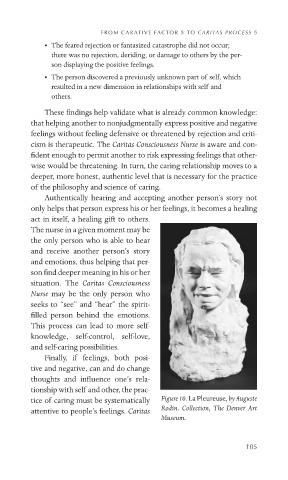
           tice of caring must be systematically   Figure 10. La Pleureuse, by Auguste
           attentive to people’s feelings. Caritas   Rodin. Collection, The Denver Art
                                             Museum.


                                                                   105

