


Page 146 - Nursing: The Philosophy and Science of Caring
P. 146
Fr om  carative Fa c t o r  6  t o   C ar it as ProC e s s  6


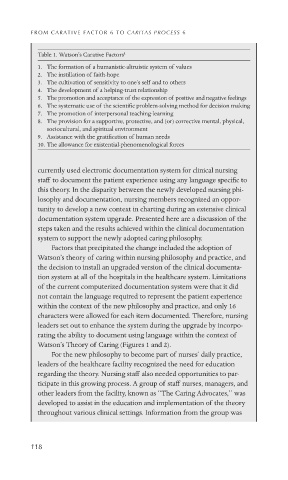
             Table 1. Watson’s Carative Factors 1
             1.  The formation of a humanistic-altruistic system of values
             2.  The instillation of faith-hope
             3.  The cultivation of sensitivity to one’s self and to others
             4.  The development of a helping-trust relationship
             5.  The promotion and acceptance of the expression of positive and negative feelings
             6.  The systematic use of the scientific problem-solving method for decision making
             7.  The promotion of interpersonal teaching-learning
             8.  The provision for a supportive, protective, and (or) corrective mental, physical,
               sociocultural, and spiritual environment
             9.  Assistance with the gratification of human needs
             10. The allowance for existential-phenomenological forces


             currently used electronic documentation system for clinical nursing
             staff to document the patient experience using any language specific to
             this theory. In the disparity between the newly developed nursing phi-
             losophy and documentation, nursing members recognized an oppor-
             tunity to develop a new context in charting during an extensive clinical
             documentation system upgrade. Presented here are a discussion of the
             steps taken and the results achieved within the clinical documentation
             system to support the newly adopted caring philosophy.
                Factors that precipitated the change included the adoption of
             Watson’s theory of caring within nursing philosophy and practice, and
             the decision to install an upgraded version of the clinical documenta-
             tion system at all of the hospitals in the healthcare system. Limitations
             of the current computerized documentation system were that it did
             not contain the language required to represent the patient experience
             within the context of the new philosophy and practice, and only 16
             characters were allowed for each item documented. Therefore, nursing
             leaders set out to enhance the system during the upgrade by incorpo-
             rating the ability to document using language within the context of
             Watson’s Theory of Caring (Figures 1 and 2).
                For the new philosophy to become part of nurses’ daily practice,
             leaders of the healthcare facility recognized the need for education
             regarding the theory. Nursing staff also needed opportunities to par-
             ticipate in this growing process. A group of staff nurses, managers, and
             other leaders from the facility, known as ‘‘The Caring Advocates,’’ was
             developed to assist in the education and implementation of the theory
             throughout various clinical settings. Information from the group was


           118

