


Page 150 - Nursing: The Philosophy and Science of Caring
P. 150
Fr om  carative Fa c t o r  6  t o   C ar it as ProC e s s  6

                Essential to the documentation process was the inclusion of out-
             comes. Because NOC will be used in the future when vendor develop-
             ment is completed, reviews of various outcomes and their application
             were completed using this taxonomy as a reference. The group devel-
             oped outcome legends that were added to the currently available list,
             again limited to 16 characters, including (1) decision-making, (2) well-
             being, (3) spirit well-being, and (4) coping. All of the outcomes devel-
             oped can be associated with the following indicators as selected by the
             clinician as (1) improved, (2) deteriorated, and (3) unchanged. These
             outcome indicators are different from the NOC scales as they do not
             provide a method of quantifying the outcome. The addition of these
             outcomes completed the necessary documentation for charting the
             patient experience as  determined within the context of the new nurs-
             ing philosophy.
                Training on the new system included not only the processes to
             input and change information, but also the new content, including
             terms associated with Watson’s theory. As only 3 hours were given to
             teach the new system, only 15 minutes were allotted for discussion and
             demonstration of the theory items. Nurses expressed excitement that
             the theory was now part of the documentation system. Handbooks
             were also supplied for nursing units that described how to use the
             theory for daily documentation of the patient experience. The new sys-
             tem included a query product that allowed extraction of information
             regarding documentation habits from the system. This product was
             used to determine if nursing staff were actually using the new theory
             documentation items. One random search of inpatient records deter-
             mined that of 274 inpatient documents, 35% had the new label selected
             and 87% had at least one carative factor documented.

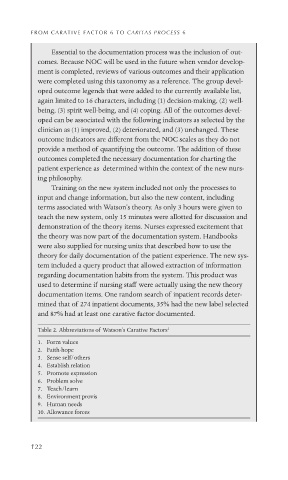
             Table 2. Abbreviations of Watson’s Carative Factors 1
             1.  Form values
             2.  Faith-hope
             3.  Sense self/others
             4.  Establish relation
             5.  Promote expression
             6.  Problem solve
             7.  Teach/learn
             8.  Environment provis
             9.  Human needs
             10. Allowance forces


           122

