


Page 148 - Nursing: The Philosophy and Science of Caring
P. 148
Fr om  carative Fa c t o r  6  t o   C ar it as ProC e s s  6

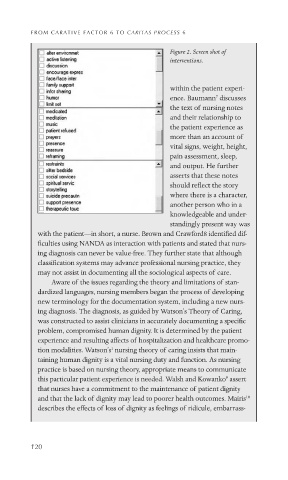
                                               Figure 2. Screen shot of
                                               interventions.


                                               within the patient experi-
                                               ence. Baumann  discusses
                                                           7
                                               the text of nursing notes
                                               and their relationship to
                                               the patient experience as
                                               more than an account of
                                               vital signs, weight, height,
                                               pain assessment, sleep,
                                               and output. He further
                                               asserts that these notes
                                               should reflect the story
                                               where there is a character,
                                               another person who in a
                                               knowledgeable and under-
                                               standingly present way was
             with the patient—in short, a nurse. Brown and Crawford8 identified dif-
             ficulties using NANDA as interaction with patients and stated that nurs-
             ing diagnosis can never be value-free. They further state that although
             classification systems may advance professional nursing practice, they
             may not assist in documenting all the sociological aspects of care.
                Aware of the issues regarding the theory and limitations of stan-
             dardized languages, nursing members began the process of developing
             new terminology for the documentation system, including a new nurs-
             ing diagnosis. The diagnosis, as guided by Watson’s Theory of Caring,
             was constructed to assist clinicians in accurately documenting a specific
             problem, compromised human dignity. It is determined by the patient
             experience and resulting affects of hospitalization and healthcare promo-
                                1
             tion modalities. Watson’s  nursing theory of caring insists that main-
             taining human dignity is a vital nursing duty and function. As nursing
             practice is based on nursing theory, appropriate means to communicate
                                                              9
             this particular patient experience is needed. Walsh and Kowanko  assert
             that nurses have a commitment to the maintenance of patient dignity
                                                                   10
             and that the lack of dignity may lead to poorer health outcomes. Mairis
             describes the effects of loss of dignity as feelings of ridicule, embarrass-


           120

