


Page 18 - PPE GUIDELINE
P. 18
Guidelines on the Use of PPE Against Chemical Hazards
b) Gas and vapour or chemical-cartridge respirators, which remove gaseous
contaminants by passing the contaminated air through material that traps the
harmful gases or vapours;
c) Powered air-purifying respirators which utilise a blower to draw in
contaminated air through a filter element that removes the contaminants and
supplies purified air to the wearer; and
d) Disposable/maintenance-free respirator, which are generally used for
protecting against particulates. Some makes incorporate charcoal into the filter
material to give additional protection against gases and vapour. These are to
be worn over a limited time or for a specific work activity such as during a
cleaning operation. They are not meant for a long-term usage.
Most air-purifying respirators are negative pressure devices except for powered-air-
purifying-respirators (PAPR), which are under positive pressure.
Supplied Air Respirators
Supplied air respirators can be classified into:
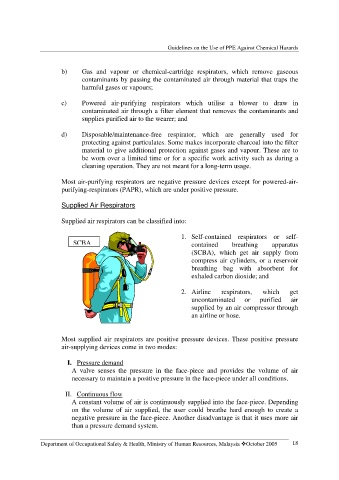
1. Self-contained respirators or self-
SCBA contained breathing apparatus
(SCBA), which get air supply from
compress air cylinders, or a reservoir
breathing bag with absorbent for
exhaled carbon dioxide; and
2. Airline respirators, which get
uncontaminated or purified air
supplied by an air compressor through
an airline or hose.
Most supplied air respirators are positive pressure devices. These positive pressure
air-supplying devices come in two modes:
I. Pressure demand
A valve senses the pressure in the face-piece and provides the volume of air
necessary to maintain a positive pressure in the face-piece under all conditions.
II. Continuous flow
A constant volume of air is continuously supplied into the face-piece. Depending
on the volume of air supplied, the user could breathe hard enough to create a
negative pressure in the face-piece. Another disadvantage is that it uses more air
than a pressure demand system.
Department of Occupational Safety & Health, Ministry of Human Resources, Malaysia October 2005 18

