


Page 17 - PPE GUIDELINE
P. 17
Guidelines on the Use of PPE Against Chemical Hazards
A negative pressure respirator has a negative pressure inside the face-piece relative to
the ambient pressure during inhalation and positive pressure during exhalation. Air for
breathing is drawn into the face-piece by the inhalation pressure. The air may be
ambient air drawn through filters or it may come from an external source (tank or
nearby clean air) through hoses.
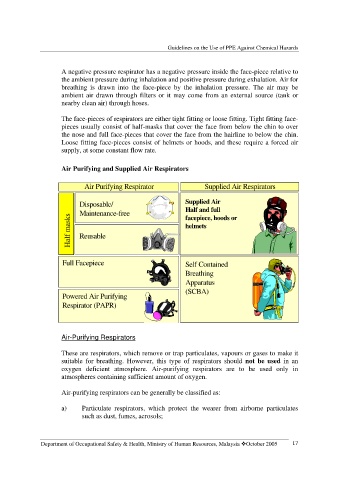
The face-pieces of respirators are either tight fitting or loose fitting. Tight fitting face-
pieces usually consist of half-masks that cover the face from below the chin to over
the nose and full face-pieces that cover the face from the hairline to below the chin.
Loose fitting face-pieces consist of helmets or hoods, and these require a forced air
supply, at some constant flow rate.
Air Purifying and Supplied Air Respirators
A
S
Air Purifying Respiratorir Purifying Respirator Supplied Air Respiratorsupplied Air Respirators
Supplied Airied Air
Disposable/ isposable/
D Suppl
H
Maintenance-freeaintenance-free
M Half and fullalf and full
Half masks Half masks Half masks Re helmetslmets
f
facepiece, hoods or acepiece, hoods or
he
Reusableusable
Ful Sel
Full Facepiecel Facepiece
Self Contained f Contained
B
Breathing reathing
A
Apparatus pparatus
( (SCBA)SCBA)
Powered Air Purifying owered Air Purifying
P
Respirator (PAPR)spirator (PAPR)
Re
Air-Purifying Respirators
These are respirators, which remove or trap particulates, vapours or gases to make it
suitable for breathing. However, this type of respirators should not be used in an
oxygen deficient atmosphere. Air-purifying respirators are to be used only in
atmospheres containing sufficient amount of oxygen.
Air-purifying respirators can be generally be classified as:
a) Particulate respirators, which protect the wearer from airborne particulates
such as dust, fumes, aerosols;
Department of Occupational Safety & Health, Ministry of Human Resources, Malaysia October 2005 17

