


Page 155 - Essentials of Nursing Leadership and Management, 5th Edition
P. 155
CikguOnline
         2208_Ch10_131-156.qxd  11/6/09  5:59 PM  Page 142
               142   unit 2 | Working Within the Organization                                                              CikguOnline
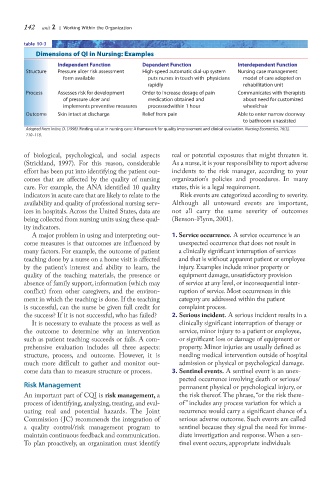
               table 10-3
                   Dimensions of QI in Nursing: Examples
                          Independent Function     Dependent Function           Interdependent Function
                Structure   Pressure ulcer risk assessment   High-speed automatic dial-up system   Nursing case management
                           form available            puts nurses in touch with  physicians   model of care adopted on
                                                     rapidly                     rehabilitation unit
                Process   Assesses risk for development   Order to increase dosage of pain   Communicates with therapists
                           of pressure ulcer and     medication obtained and     about need for customized
                           implements preventive measures  processedwithin 1 hour  wheelchair
                Outcome   Skin intact at discharge  Relief from pain            Able to enter narrow doorway
                                                                                 to bathroom unassisted
                Adapted from Irvine, D. (1998). Finding value in nursing care: A framework for quality improvement and clinical evaluation. Nursing Economics, 16(3),
                110–118.


               of biological, psychological, and social aspects  real or potential exposures that might threaten it.
               (Strickland, 1997). For this reason, considerable  As a nurse, it is your responsibility to report adverse
               effort has been put into identifying the patient out-  incidents to the risk manager, according to your
               comes that are affected by the quality of nursing  organization’s policies and procedures. In many
               care. For example, the ANA identified 10 quality  states, this is a legal requirement.
               indicators in acute care that are likely to relate to the  Risk events are categorized according to severity.
               availability and quality of professional nursing serv-  Although all untoward events are important,
               ices in hospitals. Across the United States, data are  not all carry the same severity of outcomes
               being collected from nursing units using these qual-  (Benson-Flynn, 2001).
               ity indicators.
                  A major problem in using and interpreting out-  1. Service occurrence. A service occurrence is an
               come measures is that outcomes are influenced by  unexpected occurrence that does not result in
               many factors. For example, the outcome of patient  a clinically significant interruption of services
               teaching done by a nurse on a home visit is affected  and that is without apparent patient or employee
               by the patient’s interest and ability to learn, the  injury. Examples include minor property or
               quality of the teaching materials, the presence or  equipment damage, unsatisfactory provision
               absence of family support, information (which may  of service at any level, or inconsequential inter-
               conflict) from other caregivers, and the environ-  ruption of service. Most occurrences in this
               ment in which the teaching is done. If the teaching  category are addressed within the patient
               is successful, can the nurse be given full credit for  complaint process.
               the success? If it is not successful, who has failed?  2. Serious incident. A serious incident results in a
                  It is necessary to evaluate the process as well as  clinically significant interruption of therapy or
               the outcome to determine why an intervention   service, minor injury to a patient or employee,
               such as patient teaching succeeds or fails. A com-  or significant loss or damage of equipment or
               prehensive evaluation includes all three aspects:  property. Minor injuries are usually defined as
               structure, process, and outcome. However, it is  needing medical intervention outside of hospital
               much more difficult to gather and monitor out-  admission or physical or psychological damage.
               come data than to measure structure or process.  3. Sentinel events. A sentinel event is an unex-
                                                              pected occurrence involving death or serious/
               Risk Management                                permanent physical or psychological injury, or
               An important part of CQI is risk management, a  the risk thereof. The phrase, “or the risk there-
               process of identifying, analyzing, treating, and eval-  of” includes any process variation for which a
               uating real and potential hazards. The Joint   recurrence would carry a significant chance of a
               Commission (JC) recommends the integration of   serious adverse outcome. Such events are called
               a quality control/risk management program to   sentinel because they signal the need for imme-
               maintain continuous feedback and communication.  diate investigation and response. When a sen-
               To plan proactively, an organization must identify  tinel event occurs, appropriate individuals

