


Page 19 - Essentials of Nursing Leadership and Management, 5th Edition
P. 19
CikguOnline
         2208_Ch01_001-012.qxd  11/6/09  5:54 PM  Page 6
               6   unit 1 | Professional Considerations                                                                    CikguOnline
               Behavioral Theories                           because they need little guidance. Most people,
                                                             however, flounder under this kind of leadership.
               The behavioral theories are concerned with what
               the leader does. One of the most influential theo-  Pavitt summed up the difference among these three
               ries is concerned with leadership style (White &  styles: a democratic leader tries to move the group
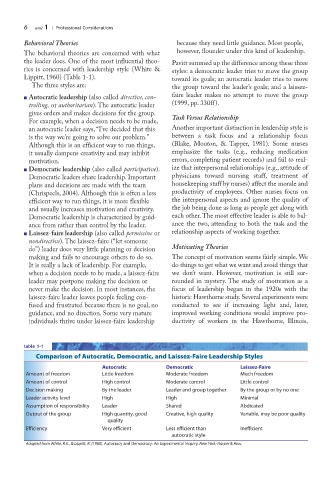
               Lippitt, 1960) (Table 1-1).                  toward its goals; an autocratic leader tries to move
                  The three styles are:                     the group toward the leader’s goals; and a laissez-
               ■ Autocratic leadership (also called directive, con-  faire leader makes no attempt to move the group
                                                            (1999, pp. 330ff).
                 trolling, or authoritarian). The autocratic leader
                 gives orders and makes decisions for the group.
                                                            Task Versus Relationship
                 For example, when a decision needs to be made,
                 an autocratic leader says, “I’ve decided that this  Another important distinction in leadership style is
                 is the way we’re going to solve our problem.”  between a task focus and a relationship focus
                 Although this is an efficient way to run things,  (Blake, Mouton, & Tapper, 1981). Some  nurses
                 it usually dampens creativity and may inhibit  emphasize the tasks (e.g., reducing medication
                 motivation.                                errors, completing patient records) and fail to real-
               ■ Democratic leadership (also called participative).  ize that interpersonal relationships (e.g., attitude of
                 Democratic leaders share leadership. Important  physicians toward nursing staff, treatment of
                 plans and decisions are made with the team  housekeeping staff by nurses) affect the morale and
                 (Chrispeels, 2004). Although this is often a less  productivity of employees. Other nurses focus on
                 efficient way to run things, it is more flexible  the interpersonal aspects and ignore the quality of
                 and usually increases motivation and creativity.  the job being done as long as people get along with
                 Democratic leadership is characterized by guid-  each other. The most effective leader is able to bal-
                 ance from rather than control by the leader.  ance the two, attending to both the task and the
               ■ Laissez-faire leadership (also called permissive or  relationship aspects of working together.
                 nondirective). The laissez-faire (“let someone
                                                            Motivating Theories
                 do”) leader does very little planning or decision
                 making and fails to encourage others to do so.  The concept of motivation seems fairly simple. We
                 It is really a lack of leadership. For example,  do things to get what we want and avoid things that
                 when a decision needs to be made, a laissez-faire  we don’t want. However, motivation is still sur-
                 leader may postpone making the decision or  rounded in mystery. The study of motivation as a
                 never make the decision. In most instances, the  focus of leadership began in the 1920s with the
                 laissez-faire leader leaves people feeling con-  historic Hawthorne study. Several experiments were
                 fused and frustrated because there is no goal, no  conducted to see if increasing light and, later,
                 guidance, and no direction. Some very mature  improved working conditions would improve pro-
                 individuals thrive under laissez-faire leadership  ductivity of workers in the Hawthorne, Illinois,


               table 1-1
                   Comparison of Autocratic, Democratic, and Laissez-Faire Leadership Styles
                                       Autocratic         Democratic            Laissez-Faire
                Amount of freedom      Little freedom     Moderate freedom      Much freedom
                Amount of control      High control       Moderate control      Little control
                Decision making        By the leader      Leader and group together  By the group or by no one
                Leader activity level  High               High                  Minimal
                Assumption of responsibility  Leader      Shared                Abdicated
                Output of the group    High quantity, good  Creative, high quality  Variable, may be poor quality
                                         quality
                Efficiency             Very efficient     Less efficient than   Inefficient
                                                            autocratic style
                Adapted from White, R.K., & Lippitt, R. (1960). Autocracy and Democracy: An Experimental Inquiry. New York: Harper & Row.

