


Page 20 - Essentials of Nursing Leadership and Management, 5th Edition
P. 20
CikguOnline
         2208_Ch01_001-012.qxd  11/6/09  5:54 PM  Page 7
                                                                         chapter 1 | Leadership and Followership 7         CikguOnline
                 electrical plant. Those workers who had the   First, learn how to recognize and understand
                 improved working conditions taken away continued  your own emotions, and learn how to manage
                 to show improved productivity. Therefore, the  them, channel them, stay calm and clear-headed,
                 answers were found not in the  conditions of the  and suspend judgment until all the facts are in
                 experiments but in the attention given to the work-  when a crisis occurs (Baggett & Baggett, 2005).
                 ers by the experimenters. Similar to the 1954  The emotionally intelligent leader welcomes con-
                 Maslow Hierarchy of Needs theory, the 1959  structive criticism, asks for help when needed, can
                 Motivation-Hygiene theory developed by Frederick  juggle multiple demands without losing focus, and
                 Herzberg looked at factors that motivated workers  can turn problems into opportunities.
                 in the workplace. Following closely after Herzberg  Second, the emotionally intelligent leader listens
                 was David McClelland and his 1961  Theory of  attentively to others, perceives unspoken concerns,
                 Needs. Clayton Alderfer responded to Maslow’s  acknowledges others’ perspectives, and brings peo-
                 theory with his own Existence, Relatedness, and  ple together in an atmosphere of respect, coopera-
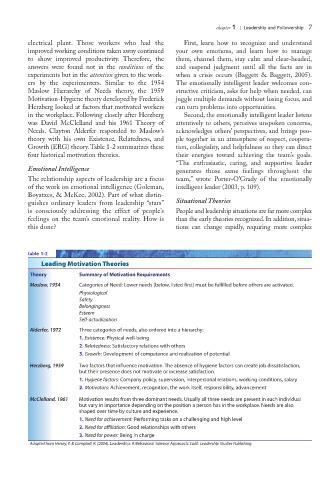
                 Growth (ERG) theory.Table 1-2 summarizes these  tion, collegiality, and helpfulness so they can direct
                 four historical motivation theories.        their energies toward achieving the team’s goals.
                                                             “The enthusiastic, caring, and supportive leader
                 Emotional Intelligence                      generates those same feelings throughout the
                 The relationship aspects of leadership are a focus  team,” wrote Porter-O’Grady of the emotionally
                 of the work on emotional intelligence (Goleman,  intelligent leader (2003, p. 109).
                 Boyatzes, & McKee, 2002). Part of what distin-
                 guishes ordinary leaders from leadership  “stars”  Situational Theories
                 is consciously addressing the effect of people’s  People and leadership situations are far more complex
                 feelings on the team’s emotional reality. How is  than the early theories recognized. In addition, situa-
                 this done?                                  tions can change rapidly, requiring more complex


                 table 1-2
                     Leading Motivation Theories

                 Theory         Summary of Motivation Requirements
                 Maslow, 1954   Categories of Need: Lower needs (below, listed first) must be fulfilled before others are activated.
                                Physiological
                                Safety
                                Belongingness
                                Esteem
                                Self-actualization
                 Alderfer, 1972  Three categories of needs, also ordered into a hierarchy:
                                1. Existence: Physical well-being
                                2. Relatedness: Satisfactory relations with others
                                3. Growth: Development of competence and realization of potential
                 Herzberg, 1959  Two factors that influence motivation. The absence of hygiene factors can create job dissatisfaction,
                                but their presence does not motivate or increase satisfaction.
                                1. Hygiene factors: Company policy, supervision, interpersonal relations, working conditions, salary
                                2. Motivators: Achievement, recognition, the work itself, responsibility, advancement
                 McClelland, 1961  Motivation results from three dominant needs. Usually all three needs are present in each individual
                                but vary in importance depending on the position a person has in the workplace. Needs are also
                                shaped over time by culture and experience.
                                1. Need for achievement: Performing tasks on a challenging and high level
                                2. Need for affiliation: Good relationships with others
                                3. Need for power: Being in charge
                 Adapted from Hersey, P. & Campbell, R. (2004). Leadership: A Behavioral Science Approach. Calif.: Leadership Studies Publishing.

