


Page 22 - Essentials of Nursing Leadership and Management, 5th Edition
P. 22
CikguOnline
         2208_Ch01_001-012.qxd  11/6/09  5:54 PM  Page 9
                                                                         chapter 1 | Leadership and Followership 9         CikguOnline
                 handle stress, and self-awareness are some of the  endeavors that require effort. It is also important
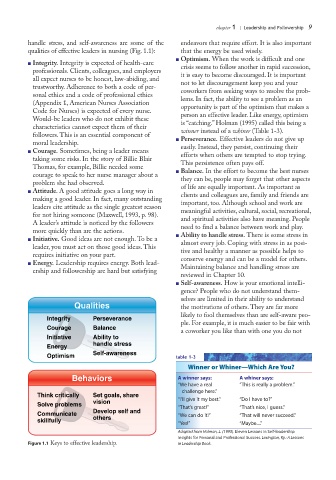
                 qualities of effective leaders in nursing (Fig. 1.1):  that the energy be used wisely.
                                                             ■ Optimism. When the work is difficult and one
                 ■ Integrity. Integrity is expected of health-care
                                                              crisis seems to follow another in rapid succession,
                  professionals. Clients, colleagues, and employers
                                                              it is easy to become discouraged. It is important
                  all expect nurses to be honest, law-abiding, and
                                                              not to let discouragement keep you and your
                  trustworthy. Adherence to both a code of per-
                                                              coworkers from seeking ways to resolve the prob-
                  sonal ethics and a code of professional ethics
                                                              lems. In fact, the ability to see a problem as an
                  (Appendix 1, American Nurses Association
                                                              opportunity is part of the optimism that makes a
                  Code for Nurses) is expected of every nurse.
                                                              person an effective leader. Like energy, optimism
                  Would-be leaders who do not exhibit these
                                                              is “catching.” Holman (1995) called this being a
                  characteristics cannot expect them of their
                                                              winner instead of a whiner (Table 1-3).
                  followers. This is an essential component of
                                                             ■ Perseverance. Effective leaders do not give up
                  moral leadership.
                                                              easily. Instead, they persist, continuing their
                 ■ Courage. Sometimes, being a leader means
                                                              efforts when others are tempted to stop trying.
                  taking some risks. In the story of Billie Blair
                                                              This persistence often pays off.
                  Thomas, for example, Billie needed some
                                                             ■ Balance. In the effort to become the best nurses
                  courage to speak to her nurse manager about a
                                                              they can be, people may forget that other aspects
                  problem she had observed.
                                                              of life are equally important. As important as
                 ■ Attitude. A good attitude goes a long way in
                                                              clients and colleagues are, family and friends are
                  making a good leader. In fact, many outstanding
                                                              important, too. Although school and work are
                  leaders cite attitude as the single greatest reason
                                                              meaningful activities, cultural, social, recreational,
                  for not hiring someone (Maxwell, 1993, p. 98).
                                                              and spiritual activities also have meaning. People
                  A leader’s attitude is noticed by the followers
                                                              need to find a balance between work and play.
                  more quickly than are the actions.
                                                             ■ Ability to handle stress. There is some stress in
                 ■ Initiative. Good ideas are not enough. To be a
                                                              almost every job. Coping with stress in as posi-
                  leader, you must act on those good ideas. This
                                                              tive and healthy a manner as possible helps to
                  requires initiative on your part.
                                                              conserve energy and can be a model for others.
                 ■ Energy. Leadership requires energy. Both lead-
                                                              Maintaining balance and handling stress are
                  ership and followership are hard but satisfying
                                                              reviewed in Chapter 10.
                                                             ■ Self-awareness. How is your emotional intelli-
                                                              gence? People who do not understand them-
                                                              selves are limited in their ability to understand
                               Qualities                      the motivations of others. They are far more
                                                              likely to fool themselves than are self-aware peo-
                      Integrity     Perseverance
                                                              ple. For example, it is much easier to be fair with
                      Courage       Balance
                                                              a coworker you like than with one you do not
                      Initiative    Ability to
                                    handle stress
                      Energy
                                    Self-awareness
                      Optimism                               table 1-3
                                                                 Winner or Whiner—Which Are You?
                              Behaviors                       A winner says:    A whiner says:
                                                              “We have a real   “This is really a problem.”
                                                               challenge here.”
                   Think critically  Set goals, share         “I’ll give it my best.”  “Do I have to?”
                                    vision
                   Solve problems                             “That’s great!”   “That’s nice, I guess.”
                                    Develop self and
                   Communicate                                “We can do it!”   “That will never succeed.”
                   skillfully       others
                                                              “Yes!”            “Maybe....”
                                                              Adapted from Holman, L. (1995). Eleven Lessons in Self-leadership:
                                                              Insights for Personal and Professional Success. Lexington, Ky.: A Lessons
                 Figure 1.1 Keys to effective leadership.     in Leadership Book.

