


Page 212 - Essentials of Nursing Leadership and Management, 5th Edition
P. 212
CikguOnline
         2208_Ch13_197-216.qxd  11/6/09  6:01 PM  Page 199
                                                                   chapter 13 | Work-Related Stress and Burnout 199        CikguOnline
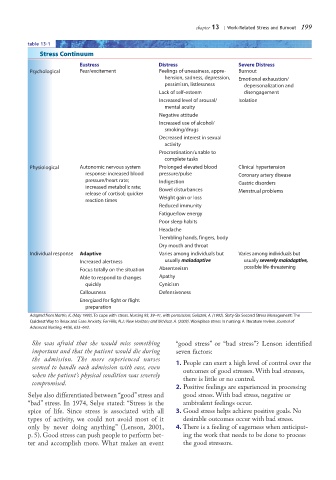
                 table 13-1
                    Stress Continuum
                                Eustress                Distress                Severe Distress
                 Psychological  Fear/excitement         Feelings of uneasiness, appre-  Burnout
                                                          hension, sadness, depression,  Emotional exhaustion/
                                                          pessimism, listlessness  depersonalization and
                                                        Lack of self-esteem      disengagement
                                                        Increased level of arousal/  Isolation
                                                          mental acuity
                                                        Negative attitude
                                                        Increased use of alcohol/
                                                          smoking/drugs
                                                        Decreased interest in sexual
                                                          activity
                                                        Procrastination/unable to
                                                          complete tasks
                 Physiological  Autonomic nervous system   Prolonged elevated blood   Clinical hypertension
                                  response: increased blood   pressure/pulse    Coronary artery disease
                                  pressure/heart rate;   Indigestion            Gastric disorders
                                  increased metabolic rate;   Bowel disturbances
                                  release of cortisol; quicker                  Menstrual problems
                                  reaction times        Weight gain or loss
                                                        Reduced immunity
                                                        Fatigue/low energy
                                                        Poor sleep habits
                                                        Headache
                                                        Trembling hands, fingers, body
                                                        Dry mouth and throat
                 Individual response  Adaptive          Varies among individuals but   Varies among individuals but
                                Increased alertness       usually maladaptive    usually severely maladaptive,
                                Focus totally on the situation  Absenteeism      possible life-threatening
                                Able to respond to changes   Apathy
                                  quickly               Cynicism
                                Callousness             Defensiveness
                                Energized for fight or flight
                                  preparation
                 Adapted from Martin, K. (May 1993). To cope with stress. Nursing 93, 39–41, with permission; Goliszek, A. (1992). Sixty-Six Second Stress Management: The
                 Quickest Way to Relax and Ease Anxiety. Far Hills, N.J.: New Horizon; and McVicar, A. (2003). Workplace stress in nursing: A literature review. Journal of
                 Advanced Nursing, 44(6), 633–642.

                  She was afraid that she would miss something  “good stress” or  “bad stress”? Lenson identified
                  important and that the patient would die during  seven factors:
                  the admission. The more experienced nurses
                                                             1. People can exert a high level of control over the
                  seemed to handle each admission with ease, even
                                                               outcomes of good stresses. With bad stresses,
                  when the patient’s physical condition was severely
                                                               there is little or no control.
                  compromised.
                                                             2. Positive feelings are experienced in processing
                 Selye also differentiated between “good”stress and  good stress. With bad stress, negative or
                 “bad” stress. In 1974, Selye stated: “Stress is the  ambivalent feelings occur.
                 spice of life. Since stress is associated with all  3. Good stress helps achieve positive goals. No
                 types of activity, we could not avoid most of it  desirable outcomes occur with bad stress.
                 only by never doing anything” (Lenson, 2001,  4. There is a feeling of eagerness when anticipat-
                 p. 5). Good stress can push people to perform bet-  ing the work that needs to be done to process
                 ter and accomplish more. What makes an event  the good stressors.

