


Page 213 - Essentials of Nursing Leadership and Management, 5th Edition
P. 213
CikguOnline
         2208_Ch13_197-216.qxd  11/6/09  6:01 PM  Page 200
               200   unit 3 | Professional Issues                                                                          CikguOnline
               5. Bad stress leaves feelings of exhaustion and  Initial Concerns
                  avoidance.                                The first few weeks on a new job are the “honey-
               6. Good stress helps growth; bad stress is limiting.  moon” phase. The new employee is excited and
                  Good stress improves interpersonal relation-  enthusiastic about the new position. Coworkers
                  ships; bad stress makes these relationships  usually go out of their way to make the new person
                  worse.                                    feel welcome and overlook any problems that arise.
               7. Processing all stress requires human action.  But honeymoons do not last forever. The new
                                                            graduate is soon expected to behave like everyone
               The Real World                               else and discovers that expectations for a profes-
                                                            sional employed in an organization are quite differ-
               Today’s health-care system has adopted the cor-  ent from expectations for a student in school.
               porate mindset. Both the new graduate and the  Those behaviors that brought rewards in school are
               seasoned professional continue to experience  not necessarily valued by the organization. In fact,
               redesigning, changing staffing models, complex  some of them are criticized.The new graduate who
               documentation requirements, continued nursing  is not prepared for this change feels confused,
               shortages, and the expectation that work does not  shocked, angry, and disillusioned. The tension of
               end when the employee goes home (Trossman,   the situation can become almost unbearable if it is
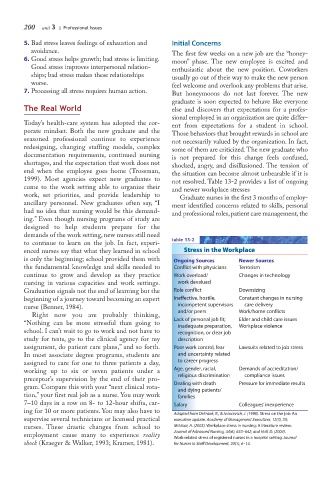
               1999). Most agencies expect new graduates to  not resolved. Table 13-2 provides a list of ongoing
               come to the work setting able to organize their  and newer workplace stresses
               work, set priorities, and provide leadership to  Graduate nurses in the first 3 months of employ-
               ancillary personnel. New graduates often say, “I  ment identified concerns related to skills, personal
               had no idea that nursing would be this demand-  and professional roles,patient care management,the
               ing.” Even though nursing programs of study are
               designed to help students prepare for the
               demands of the work setting, new nurses still need
                                                            table 13-2
               to continue to learn on the job. In fact, experi-
               enced nurses say that what they learned in school  Stress in the Workplace
               is only the beginning; school provided them with  Ongoing Sources  Newer Sources
               the fundamental knowledge and skills needed to  Conflict with physicians  Terrorism
               continue to grow and develop as they practice  Work overload/    Changes in technology
               nursing in various capacities and work settings.  work devalued
               Graduation signals not the end of learning but the  Role conflict  Downsizing
               beginning of a journey toward becoming an expert  Ineffective, hostile,   Constant changes in nursing
               nurse (Benner, 1984).                          incompetent supervisors  care delivery
                                                              and/or peers      Work/home conflicts
                  Right now you are probably thinking,
                                                            Lack of personal job fit;   Elder and child care issues
               “Nothing can be more stressful than going to
                                                              inadequate preparation,   Workplace violence
               school. I can’t wait to go to work and not have to  recognition, or clear job
               study for tests, go to the clinical agency for my  description
               assignment, do patient care plans,” and so forth.  Poor work control, fear   Lawsuits related to job stress
               In most associate degree programs, students are  and uncertainty related
               assigned to care for one to three patients a day,  to career progress
               working up to six or seven patients under a   Age, gender, racial,   Demands of accreditation/
                                                              religious discrimination  compliance issues
               preceptor’s supervision by the end of their pro-
                                                            Dealing with death   Pressure for immediate results
               gram. Compare this with your “next clinical rota-
                                                              and dying patients/
               tion,” your first real job as a nurse. You may work  families
               7–10 days in a row on 8- to 12-hour shifts, car-  Salary         Colleagues’inexperience
               ing for 10 or more patients. You may also have to  Adapted from DeFrank, R., & Ivancevich, J. (1998). Stress on the job: An
               supervise several technicians or licensed practical  executive update. Academy of Management Executives, 12(3), 55;
               nurses. These drastic changes from school to  McVicar, A. (2003). Workplace stress in nursing: A literature review.
                                                            Journal of Advanced Nursing, 44(6), 633–642; and Hall, D. (2004).
               employment cause many to experience  reality  Work-related stress of registered nurses in a hospital setting. Journal
               shock (Kraeger & Walker, 1993; Kramer, 1981).  for Nurses in Staff Development, 20(1), 6–14.

