


Page 214 - Essentials of Nursing Leadership and Management, 5th Edition
P. 214
CikguOnline
         2208_Ch13_197-216.qxd  11/6/09  6:01 PM  Page 201
                                                                   chapter 13 | Work-Related Stress and Burnout 201        CikguOnline
                 shocks of bad experiences, the affirmations of good  current strengths, weaknesses, opportunities, and
                 experiences, constructive evaluation, knowledge of  threats. Where do you see yourself in 1 year? 5
                 the unit routine,and priorities of school versus work  years? How will you fit yourself into your work to
                 (Godinez, Schweiger, Gruver, & Ryan, 1999;    meet your goals?
                 Heslop, 2001).                              3. The way you perceive events on the job will
                   Well-supervised orientation programs are very  influence how you feel about your work. Your
                 helpful for newly licensed nurses. In this era of the  attitude will affect whether work is a pleasant or
                 nursing shortage, the orientation program may be  unpleasant experience. Health care is not easy.
                 cut short and the new nurse required to function on  Sick people can be cranky and demanding. Health-
                 his or her own very quickly. One way to minimize  care agencies continue to want to do more with less.
                 initial work stress is to ask questions about the ori-  How you perceive your contribution to the health-
                 entation program: How long will it be? Whom will  care system will definitely influence your reality.
                 I be working with? When will I be on my own?  4. Feelings of helplessness and powerlessness at
                 What happens if at the end of the orientation I still  work cause frustration and unrelieved job
                 need more assistance?                         stress. If you go to work every day feeling that
                                                               you do not make a difference, it is time to
                 Differences in Expectations                   reevaluate your position and your goals.
                 The enthusiasm and eagerness of the first new job
                                                             What are these differences in expectations?
                 quickly disappear as reality sets in. Regardless of
                                                             Kramer (1981), who studied reality shock for
                 the career one chooses, there is no perfect job. The
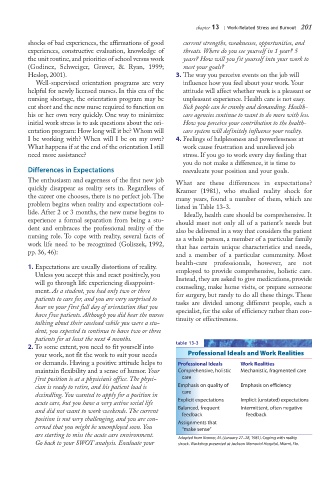
                                                             many years, found a number of them, which are
                 problem begins when reality and expectations col-
                                                             listed in Table 13-3.
                 lide. After 2 or 3 months, the new nurse begins to
                                                               Ideally, health care should be comprehensive. It
                 experience a formal separation from being a stu-
                                                             should meet not only all of a patient’s needs but
                 dent and embraces the professional reality of the
                                                             also be delivered in a way that considers the patient
                 nursing role. To cope with reality, several facts of
                                                             as a whole person, a member of a particular family
                 work life need to be recognized (Goliszek, 1992,
                                                             that has certain unique characteristics and needs,
                 pp. 36, 46):
                                                             and a member of a particular community. Most
                                                             health-care professionals, however, are not
                 1. Expectations are usually distortions of reality.
                                                             employed to provide comprehensive, holistic care.
                   Unless you accept this and react positively, you
                                                             Instead, they are asked to give medications, provide
                   will go through life experiencing disappoint-
                                                             counseling, make home visits, or prepare someone
                   ment. As a student, you had only two or three
                                                             for surgery, but rarely to do all these things. These
                   patients to care for, and you are very surprised to
                                                             tasks are divided among different people, each a
                   hear on your first full day of orientation that you
                                                             specialist, for the sake of efficiency rather than con-
                   have five patients. Although you did hear the nurses
                                                             tinuity or effectiveness.
                   talking about their caseload while you were a stu-
                   dent, you expected to continue to have two or three
                   patients for at least the next 4 months.
                                                             table 13-3
                 2. To some extent, you need to fit yourself into
                   your work, not fit the work to suit your needs  Professional Ideals and Work Realities
                   or demands. Having a positive attitude helps to  Professional Ideals  Work Realities
                   maintain flexibility and a sense of humor. Your  Comprehensive, holistic   Mechanistic, fragmented care
                   first position is at a physician’s office. The physi-  care
                   cian is ready to retire, and his patient load is  Emphasis on quality of   Emphasis on efficiency
                                                               care
                   dwindling. You wanted to apply for a position in
                                                              Explicit expectations  Implicit (unstated) expectations
                   acute care, but you have a very active social life
                                                              Balanced, frequent   Intermittent, often negative
                   and did not want to work weekends. The current
                                                               feedback           feedback
                   position is not very challenging, and you are con-
                                                              Assignments that
                   cerned that you might be unemployed soon. You
                                                               “make sense”
                   are starting to miss the acute care environment.
                                                              Adapted from Kramer, M. (January 27–28, 1981). Coping with reality
                   Go back to your SWOT analysis. Evaluate your  shock. Workshop presented at Jackson Memorial Hospital, Miami, Fla.

