


Page 218 - Essentials of Nursing Leadership and Management, 5th Edition
P. 218
CikguOnline
         2208_Ch13_197-216.qxd  11/6/09  6:01 PM  Page 205
                                                                   chapter 13 | Work-Related Stress and Burnout 205        CikguOnline
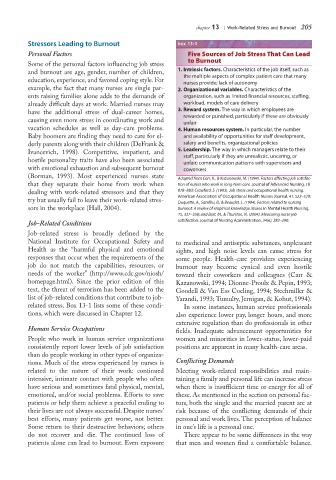
                 Stressors Leading to Burnout                 box 13-1
                 Personal Factors                                Five Sources of Job Stress That Can Lead
                                                                 to Burnout
                 Some of the personal factors influencing job stress
                 and burnout are age, gender, number of children,  1. Intrinsic factors. Characteristics of the job itself, such as
                                                               the multiple aspects of complex patient care that many
                 education, experience, and favored coping style. For
                                                               nurses provide; lack of autonomy
                 example, the fact that many nurses are single par-  2. Organizational variables. Characteristics of the
                 ents raising families alone adds to the demands of  organization, such as limited financial resources, staffing,
                 already difficult days at work. Married nurses may  workload, models of care delivery
                 have the additional stress of dual-career homes,  3. Reward system. The way in which employees are
                                                               rewarded or punished, particularly if these are obviously
                 causing even more stress in coordinating work and
                                                               unfair
                 vacation schedules as well as day-care problems.  4. Human resources system. In particular, the number
                 Baby boomers are finding they need to care for el-  and availability of opportunities for staff development,
                 derly parents along with their children (DeFrank &  salary and benefits, organizational policies
                 Ivancevich, 1998). Competitive, impatient, and  5. Leadership. The way in which managers relate to their
                                                               staff, particularly if they are unrealistic, uncaring, or
                 hostile personality traits have also been associated
                                                               unfair; communication patterns with supervisors and
                 with emotional exhaustion and subsequent burnout  coworkers
                 (Borman, 1993). Most experienced nurses state
                                                              Adapted from Carr, K., & Kazanowski, M. (1994). Factors affecting job satisfac-
                 that they separate their home from work when  tion of nurses who work in long-term care. Journal of Advanced Nursing, 19,
                 dealing with work-related stressors and that they  878–883; Crawford, S. (1993). Job stress and occupational health nursing.
                                                              American Association of Occupational Health Nurses Journal, 41, 522–529;
                 try but usually fail to leave their work-related stres-
                                                              Duquette, A., Sandhu, B., & Beaudet, L. (1994). Factors related to nursing
                 sors in the workplace (Hall, 2004).          burnout: A review of empirical knowledge. Issues in Mental Health Nursing,
                                                              15, 337–358; and Best, M., & Thurston, N. (2004). Measuring nurse job
                                                              satisfaction, Journal of Nursing Administration, 34(6), 283–290.
                 Job-Related Conditions
                 Job-related stress is broadly defined by the
                 National Institute for Occupational Safety and  to medicinal and antiseptic substances, unpleasant
                 Health as the  “harmful physical and emotional  sights, and high noise levels can cause stress for
                 responses that occur when the requirements of the  some people. Health-care providers experiencing
                 job do not match the capabilities, resources, or  burnout may become cynical and even hostile
                 needs of the worker” (http://www.cdc.gov/niosh/  toward their coworkers and colleagues (Carr &
                 homepage.html). Since the prior edition of this  Kazanowski, 1994; Dionne-Proulx & Pepin, 1993;
                 text, the threat of terrorism has been added to the  Goodell & Van Ess Coeling, 1994; Stechmiller &
                 list of job-related conditions that contribute to job-  Yarandi, 1993; Tumulty, Jernigan, & Kohut, 1994).
                 related stress. Box 13-1 lists some of these condi-  In some instances, human service professionals
                 tions, which were discussed in Chapter 12.  also experience lower pay, longer hours, and more
                                                             extensive regulation than do professionals in other
                 Human Service Occupations                   fields. Inadequate advancement opportunities for
                 People who work in human service organizations  women and minorities in lower-status, lower-paid
                 consistently report lower levels of job satisfaction  positions are apparent in many health-care areas.
                 than do people working in other types of organiza-
                 tions. Much of the stress experienced by nurses is  Conflicting Demands
                 related to the nature of their work: continued  Meeting work-related responsibilities and main-
                 intensive, intimate contact with people who often  taining a family and personal life can increase stress
                 have serious and sometimes fatal physical, mental,  when there is insufficient time or energy for all of
                 emotional, and/or social problems. Efforts to save  these. As mentioned in the section on personal fac-
                 patients or help them achieve a peaceful ending to  tors, both the single and the married parent are at
                 their lives are not always successful. Despite nurses’  risk because of the conflicting demands of their
                 best efforts, many patients get worse, not better.  personal and work lives. The perception of balance
                 Some return to their destructive behaviors; others  in one’s life is a personal one.
                 do not recover and die. The continued loss of  There appear to be some differences in the way
                 patients alone can lead to burnout. Even exposure  that men and women find a comfortable balance.

