


Page 90 - Essentials of Nursing Leadership and Management, 5th Edition
P. 90
CikguOnline
         2208_Ch06_071-090.qxd  11/6/09  5:57 PM  Page 77
                                                                     chapter 6 | Getting People to Work Together 77        CikguOnline
                 without intending this to happen.Consider the fol-  for sharing information. These mechanisms allow
                 lowing example:                             the nurses from the previous shift to complete their
                                                             tasks and those coming on duty to make inquiries
                  A respiratory therapist and a department adminis-
                                                             for clarification as necessary.
                  trator at a large health-care institution were
                                                               The report should be organized, concise, and
                  engaged in a relationship.They started sending each
                                                             complete, with relevant details. Not every unit uses
                  other personal notes over the company e-mail sys-
                                                             the same system for giving a change-of-shift
                  tem. One day, one of them accidentally sent one of
                                                             report. The system is easily modified according to
                  these notes to all the employees at the health-care
                                                             the pattern of nursing care delivery and the types of
                  institution. Both were fired. The moral of this story
                                                             patients serviced. For example, many intensive care
                  is simple: Do not send anything by e-mail that you
                                                             units,because of their small size and the more acute
                  would not want published on the front page of a
                                                             needs of their patients, use walking rounds as a
                  national newspaper or hear on your favorite radio
                                                             means for giving the report. This system allows
                  station tomorrow morning.
                                                             nurses to discuss the current patient status and to
                 Although voice tone cannot be “heard” in e-mail,  set goals for care for the next several hours.
                 the use of certain words and writing styles indicates  Together, the nurses gather objective data as one
                 emotion. A rude tone in an e-mail message may  nurse ends a shift and another begins. This way,
                 provoke extreme reactions.Follow the “rules of neti-  there is no confusion as to the patient’s status at
                 quette” (Shea, 2000) when communicating through  shift change. This same system is often used in
                 e-mail. Some of these rules are listed in Box 6-3.  emergency departments and labor and delivery
                                                             units. Larger patient care units may find the “walk-
                 Reporting Patient Information               ing report” time-consuming and an inefficient use
                                                             of resources.
                 Change-of-Shift Report                        It is helpful to take notes or create a worksheet
                 It is important to understand exactly how your day  while listening to the report. A worksheet helps
                 at work will begin.Regardless of which shift an indi-
                 vidual works, some things never change. Nurses
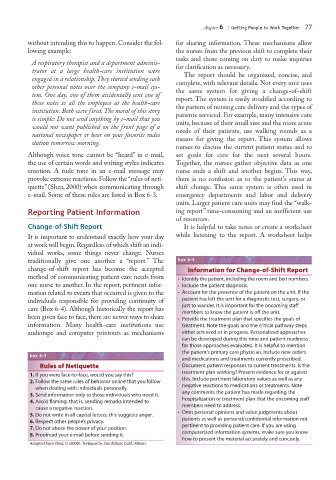
                 traditionally give one another a  “report.” The  box 6-4
                 change-of-shift report has become the accepted  Information for Change-of-Shift Report
                 method of communicating patient care needs from  • Identify the patient, including the room and bed numbers.
                 one nurse to another. In the report, pertinent infor-  • Include the patient diagnosis.
                 mation related to events that occurred is given to the  • Account for the presence of the patient on the unit. If the
                 individuals responsible for providing continuity of  patient has left the unit for a diagnostic test, surgery, or
                                                               just to wander, it is important for the oncoming staff
                 care (Box 6-4). Although historically the report has
                                                               members to know the patient is off the unit.
                 been given face to face,there are newer ways to share  • Provide the treatment plan that specifies the goals of
                 information. Many health-care institutions use  treatment. Note the goals and the critical pathway steps
                 audiotape and computer printouts as mechanisms  either achieved or in progress. Personalized approaches
                                                               can be developed during this time and patient readiness
                                                               for those approaches evaluated. It is helpful to mention
                                                               the patient’s primary care physician. Include new orders
                 box 6-3
                                                               and medications and treatments currently prescribed.
                    Rules of Netiquette                       • Document patient responses to current treatments. Is the
                                                               treatment plan working? Present evidence for or against
                 1. If you were face-to-face, would you say this?
                 2. Follow the same rules of behavior online that you follow  this. Include pertinent laboratory values as well as any
                   when dealing with individuals personally.   negative reactions to medications or treatments. Note
                 3. Send information only to those individuals who need it.  any comments the patient has made regarding the
                 4. Avoid flaming; that is, sending remarks intended to  hospitalization or treatment plan that the oncoming staff
                   cause a negative reaction.                  members need to address.
                 5. Do not write in all capital letters; this suggests anger.  • Omit personal opinions and value judgments about
                 6. Respect other people’s privacy.            patients as well as personal/confidential information not
                 7. Do not abuse the power of your position.   pertinent to providing patient care. If you are using
                 8. Proofread your e-mail before sending it.   computerized information systems, make sure you know
                                                               how to present the material accurately and concisely.
                 Adapted from Shea, V. (2000).  Netiquette. San Rafael, Calif.: Albion.

