


Page 125 - ANUAL REPORT MOH 2017
P. 125
•   Travel Advisory
             The International Health Sector prepares and reviews the Travel Advisory information uploaded in the
             Ministry of Health’s MyHEALTH Portal at the http://www.myhealth.gov.my/myhealth/. In addition, the
             International Health Sector provides technical advice to the public on Travel Health enquiries through
             MyHEALTH Portal from time to time.

             Activities at International Points of Entry


             i.  Screening of Travellers Arriving from Countries with Risk of Yellow Fever Transmission
             Malaysia is still free from Yellow Fever. However, this country has a high risk of acquiring this disease.
             There are several routine activities implemented in this country in preventing Yellow Fever transmission,
             such as Yellow Fever vaccination is requirement entry, screening at the International Points of Entry
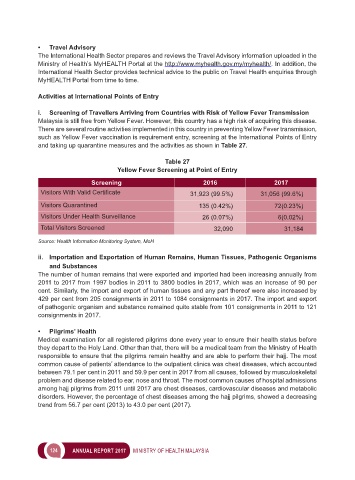
             and taking up quarantine measures and the activities as shown in Table 27.

                                                      Table 27
                                       Yellow Fever Screening at Point of Entry

                              Screening                           2016                   2017
              Visitors With Valid Certificate                 31,923 (99.5%)        31,056 (99.6%)
              Visitors Quarantined                               135 (0.42%)             72(0.23%)
              Visitors Under Health Surveillance                  26 (0.07%)              6(0.02%)
              Total Visitors Screened                                32,090                 31,184

             Source: Health Information Monitoring System, MoH

             ii.  Importation and Exportation of Human Remains, Human Tissues, Pathogenic Organisms
                 and Substances
             The number of human remains that were exported and imported had been increasing annually from
             2011 to 2017 from 1997 bodies in 2011 to 3800 bodies in 2017, which was an increase of 90 per
             cent. Similarly, the import and export of human tissues and any part thereof were also increased by
             429 per cent from 205 consignments in 2011 to 1084 consignments in 2017. The import and export
             of pathogenic organism and substance remained quite stable from 101 consignments in 2011 to 121
             consignments in 2017.

             •   Pilgrims’ Health
             Medical examination for all registered pilgrims done every year to ensure their health status before
             they depart to the Holy Land. Other than that, there will be a medical team from the Ministry of Health
             responsible to ensure that the pilgrims remain healthy and are able to perform their hajj. The most
             common cause of patients’ attendance to the outpatient clinics was chest diseases, which accounted
             between 79.1 per cent in 2011 and 59.9 per cent in 2017 from all causes, followed by musculoskeletal
             problem and disease related to ear, nose and throat. The most common causes of hospital admissions
             among hajj pilgrims from 2011 until 2017 are chest diseases, cardiovascular diseases and metabolic
             disorders. However, the percentage of chest diseases among the hajj pilgrims, showed a decreasing
             trend from 56.7 per cent (2013) to 43.0 per cent (2017).


                 124    ANNUAL REPORT 2017     MINISTRY OF HEALTH MALAYSIA

