


Page 147 - ANUAL REPORT MOH 2017
P. 147
PRIMARY EMERGENCY MEDICAL CARE
             The provision of emergency services at primary healthcare facilities continued to put emphasize on
             the importance of delivering quality services. The ambulance fleet was further strengthened with the
             allocation of 175 new ambulances for health clinics. This is to ensure a modern fleet is available that
             is reliable and prepared to meet the gruelling demands of a 24-hour emergency services. In 2017, 12
             ambulances were delivered to Melaka (8) and Negeri Sembilan (4). The remaining 163 ambulances
             will be distributed in 2018.

             More than 350 health clinics were in Medical Emergency Coordinating Centres (MECC) network. Focus
             on safety of health staff accompanying patients in the ambulance was issued to all the states in the
             form of a circular Surat Pekeliling Ketua Pengarah Kesihatan Bilangan 5/2017 Keselamatan Anggota
             Yang Mengiringi Pesakit Dalam Ambulans Kementerian Kesihatan Malaysia Rujukan KKM 600-30/12/30
             Jld.2(213) dated 26 July 2017.

             100 per cent of emergency cases were attended within less than one (1) minute during office hours.
             The target for emergency response within 15 minutes after office hours was set at 95 per cent and
             the achieved rate was 97.1 per cent in 2017. Currently, 533 clinics have been connected with the
             Emergency Alert System. In 2017, 30,943 cases as compared to 20,328 cases in 2016 were attended
             through this system. Training in Basic Life Support (BLS) for the Assistant Medical Officers (AMO) is
             a Key Performance Indicator for the District Medical Officer of Health. The percentage of AMOs with a
             valid BLS certificate increased from 89.4 per cent in 2015 to 97 per cent in 2017.

             PRIMARY HEALTH CARE INFORMATICS

             TELEPRIMARY CARE (TPC)

             Teleprimary Care (TPC) is a Health Information System that connects primary and secondary healthcare
             facilities. The backbone for this system is the TPC application developed by the Ministry of Health
             Malaysia. The application caters to patient care from registration, consultation, order management,
             referral and allocation of follow-up appointment at the ambulatory care setting. Since 2005, TPC is being
             used in 89 primary health care facilities and specialist outpatient clinics in 6 hospitals. This accounts for
             only 9 per cent of primary care facilities. TPC will be migrated to Teleprimary Care-Oral Health Clinical
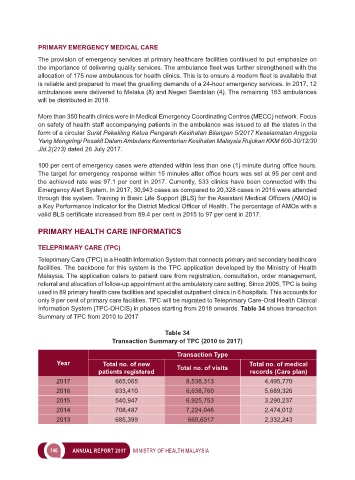
             Information System (TPC-OHCIS) in phases starting from 2018 onwards. Table 34 shows transaction
             Summary of TPC from 2010 to 2017


                                                      Table 34
                                     Transaction Summary of TPC (2010 to 2017)

                                                          Transaction Type
                   Year           Total no. of new                               Total no. of medical
                                patients registered       Total no. of visits    records (Care plan)
                   2017               665,065               8,538,313                 4,495,770
                   2016               633,410               6,638,760                 5,689,326
                   2015               540,947               6,925,753                 3,290,237
                   2014               708,487               7,224,046                 2,474,012
                   2013               685,399                660,6017                 2,332,243


                 146    ANNUAL REPORT 2017     MINISTRY OF HEALTH MALAYSIA

