


Page 101 - alligood 8th edition_Neat
P. 101
82     UNIT II  Nursing Philosophies

           Emmanuael Levinas (1969) and Danish philosopher   give  special  attention,  if  not  loving  attention.”  As
           Knud Løgstrup (1995) as foundational to her work.  carative  factors  evolved  within  an  expanding  per-
             Watson’s  main  concepts  include  the  10  carative   spective, and as her ideas and values evolved, Watson
           factors (see Major Concepts & Definitions box and   offered a translation of the original carative factors
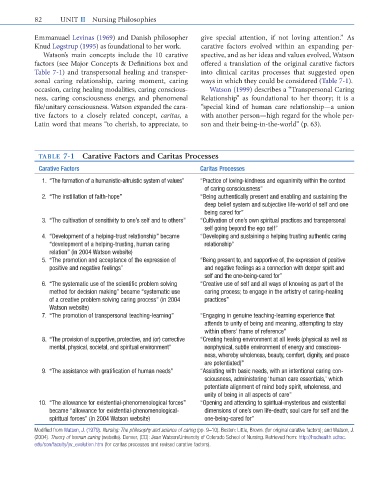
           Table 7-1) and transpersonal healing and transper-  into  clinical  caritas  processes  that  suggested  open
           sonal  caring  relationship,  caring  moment,  caring    ways in which they could be considered (Table 7-1).
           occasion, caring healing modalities, caring conscious-  Watson (1999) describes a “Transpersonal Caring
           ness,  caring  consciousness  energy,  and  phenomenal   Relationship”  as  foundational  to  her  theory;  it  is  a
           file/unitary consciousness. Watson expanded the cara-  “special  kind  of  human  care  relationship—a  union
           tive  factors  to  a  closely  related  concept,  caritas,  a   with another person—high regard for the whole per-
           Latin word that means “to cherish, to appreciate, to   son and their being-in-the-world” (p. 63).


            TABLE 7-1  Carative Factors and Caritas Processes
            Carative Factors                             Caritas Processes

              1.  “The formation of a humanistic-altruistic system of values”  “Practice of loving-kindness and equanimity within the context
                                                          of caring consciousness”
              2.  “The instillation of faith-hope”       “Being authentically present and enabling and sustaining the
                                                          deep belief system and subjective life-world of self and one
                                                          being cared for”
              3.  “The cultivation of sensitivity to one’s self and to others”  “Cultivation of one’s own spiritual practices and transpersonal
                                                          self going beyond the ego self”
              4.  “Development of a helping-trust relationship” became   “Developing and sustaining a helping trusting authentic caring
               “development of a helping-trusting, human caring    relationship”
               relation” (in 2004 Watson website)
              5.  “The promotion and acceptance of the expression of    “Being present to, and supportive of, the expression of positive
               positive and negative feelings”            and negative feelings as a connection with deeper spirit and
                                                          self and the one-being-cared for”
              6.  “The systematic use of the scientific problem solving   “Creative use of self and all ways of knowing as part of the
               method for decision making” became “systematic use    caring process; to engage in the artistry of caring-healing
               of a creative problem solving caring process” (in 2004   practices”
               Watson website)
              7.  “The promotion of transpersonal teaching-learning”  “Engaging in genuine teaching-learning experience that
                                                          attends to unity of being and meaning, attempting to stay
                                                          within others’ frame of reference”
              8.  “The provision of supportive, protective, and (or) corrective   “Creating healing environment at all levels (physical as well as
               mental, physical, societal, and spiritual environment”  nonphysical, subtle environment of energy and conscious-
                                                          ness, whereby wholeness, beauty, comfort, dignity, and peace
                                                          are potentiated)”
              9.  “The assistance with gratification of human needs”  “Assisting with basic needs, with an intentional caring con-
                                                          sciousness, administering ‘human care essentials,’ which
                                                          potentiate alignment of mind body spirit, wholeness, and
                                                          unity of being in all aspects of care”
              10.  “The allowance for existential-phenomenological forces”   “Opening and attending to spiritual-mysterious and existential
               became “allowance for existential-phenomenological-  dimensions of one’s own life-death; soul care for self and the
               spiritual forces” (in 2004 Watson website)  one-being-cared for”
           Modified from Watson, J. (1979). Nursing: The philosophy and science of caring (pp. 9–10). Boston: Little, Brown. (for original carative factors); and Watson, J.
           (2004). Theory of human caring (website). Denver, (CO): Jean Watson/University of Colorado School of Nursing. Retrieved from: http://hschealth.uchsc.
           edu/son/faculty/jw_evolution.htm (for caritas processes and revised carative factors).

