


Page 44 - alligood 8th edition_Neat
P. 44
CHAPTER 3  Theory Development Process  25

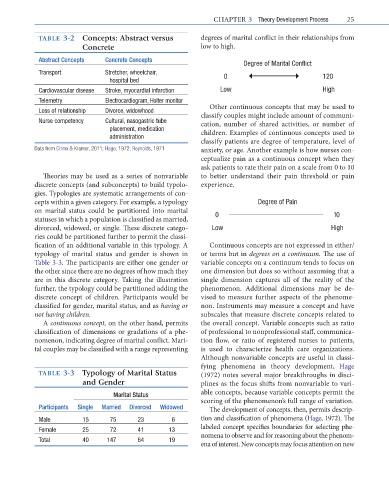
            TABLE 3-2   Concepts: Abstract versus        degrees of marital conflict in their relationships from
                        Concrete                         low to high.

            Abstract Concepts  Concrete Concepts
                                                                     Degree of Marital Conflict
            Transport         Stretcher, wheelchair,           0                           120
                               hospital bed
            Cardiovascular disease  Stroke, myocardial infarction  Low                         High
            Telemetry         Electrocardiogram, Holter monitor
                                                           Other continuous concepts that may be used to
            Loss of relationship  Divorce, widowhood     classify couples might include amount of communi-
            Nurse competency  Cultural, nasogastric tube    cation,  number  of  shared  activities,  or  number  of
                               placement, medication     children. Examples of continuous concepts used to
                               administration
                                                         classify patients are degree of temperature, level of
           Data from Chinn & Kramer, 2011; Hage, 1972; Reynolds, 1971  anxiety, or age. Another example is how nurses con-
                                                         ceptualize pain as a continuous concept when they
                                                         ask patients to rate their pain on a scale from 0 to 10
             Theories  may  be  used  as  a  series  of  nonvariable   to  better  understand  their  pain  threshold  or  pain
           discrete concepts (and subconcepts) to build typolo-  experience.
           gies. Typologies are systematic arrangements of con-
           cepts within a given category. For example, a typology        Degree of Pain
           on  marital  status  could  be  partitioned  into  marital   0                      10
           statuses in which a population is classified as married,
           divorced, widowed, or single. These discrete catego-  Low                              High
           ries could be partitioned further to permit the classi-
           fication of an additional variable in this typology. A   Continuous concepts are not expressed in either/
           typology  of  marital  status  and  gender  is  shown  in   or terms but in degrees on a continuum. The use of
           Table 3-3. The participants are either one gender or   variable concepts on a continuum tends to focus on
           the other since there are no degrees of how much they   one dimension but does so without assuming that a
           are  in  this  discrete  category.  Taking  the  illustration   single  dimension  captures  all  of  the  reality  of  the
           further, the typology could be partitioned adding the   phenomenon.  Additional  dimensions  may  be  de-
           discrete  concept  of  children.  Participants  would  be   vised  to  measure  further  aspects  of  the  phenome-
           classified for gender, marital status, and as having or   non. Instruments may measure a concept and have
           not having children.                          subscales that measure discrete concepts related to
             A continuous concept, on the other hand, permits   the overall concept. Variable concepts such as ratio
           classification  of  dimensions  or  gradations  of  a  phe-  of professional to nonprofessional staff, communica-
           nomenon, indicating degree of marital conflict. Mari-  tion  flow,  or  ratio  of  registered  nurses  to  patients,
           tal couples may be classified with a range representing   is  used  to  characterize  health  care  organizations.
                                                         Although nonvariable concepts are useful in classi-
                                                         fying  phenomena  in  theory  development,  Hage
            TABLE 3-3   Typology of Marital Status       (1972) notes several major breakthroughs in disci-
                        and Gender                       plines as the focus shifts from nonvariable to vari-
                                 Marital Status          able concepts, because variable concepts permit the
                                                         scoring of the phenomenon’s full range of variation.
            Participants  Single  Married  Divorced  Widowed  The development of concepts, then, permits descrip-
            Male        15       75    23         6      tion and classification of phenomena (Hage, 1972). The
            Female      25       72    41       13       labeled concept specifies boundaries for selecting phe-
                                                         nomena to observe and for reasoning about the phenom-
            Total       40     147     64       19
                                                         ena of interest. New concepts may focus attention on new

