


Page 45 - alligood 8th edition_Neat
P. 45
26     UNIT I  Evolution of Nursing Theories

           phenomena or facilitate thinking about phenomena in a   relate the concepts to observable phenomena specify-
           different way (Hage, 1972). Scholarly analysis of the con-  ing empirical indicators. Table 3-5 provides examples
           cepts in nursing theories is a critical beginning step in the   of  concepts  with  their  theoretical  and  operational
           process of theoretical inquiry. The concept process con-  definitions. These linkages are vital to the logic of the
           tinues to flourish with many examples in the nursing lit-  theory, its observation, and its measurement.
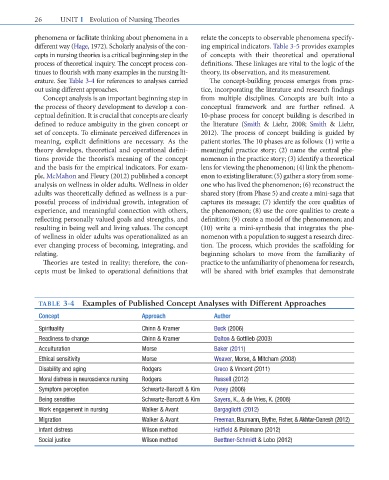
           erature. See Table 3-4 for references to analyses carried   The  concept-building  process  emerges  from  prac-
           out using different approaches.               tice, incorporating the literature and research findings
             Concept analysis is an important beginning step in   from  multiple  disciplines.  Concepts  are  built  into  a
           the process of theory development to develop a con-  conceptual  framework  and  are  further  refined.  A
           ceptual definition. It is crucial that concepts are clearly   10-phase process for concept building is described in
           defined to reduce ambiguity in the given concept or   the  literature  (Smith  &  Liehr,  2008;  Smith  &  Liehr,
           set of concepts. To eliminate perceived differences in   2012).  The  process  of  concept  building  is  guided  by
           meaning,  explicit  definitions  are  necessary.  As  the   patient stories. The 10 phases are as follows: (1) write a
           theory  develops,  theoretical  and  operational  defini-  meaningful  practice  story;  (2)  name  the  central  phe-
           tions  provide  the  theorist’s  meaning  of  the  concept   nomenon in the practice story; (3) identify a theoretical
           and the basis for the empirical indicators. For exam-  lens for viewing the phenomenon; (4) link the phenom-
           ple, McMahon and Fleury (2012) published a concept   enon to existing literature; (5) gather a story from some-
           analysis on wellness in older adults. Wellness in older   one who has lived the phenomenon; (6) reconstruct the
           adults was theoretically defined as wellness is a pur-  shared story (from Phase 5) and create a mini-saga that
           poseful process of individual growth, integration of   captures its message; (7) identify the core qualities of
           experience, and meaningful connection with others,   the phenomenon; (8) use the core qualities to create a
           reflecting personally valued goals and strengths, and   definition; (9) create a model of the phenomenon; and
           resulting in being well and living values. The concept   (10)  write  a  mini-synthesis  that  integrates  the  phe-
           of wellness in older adults was operationalized as an   nomenon with a population to suggest a research direc-
           ever changing process of becoming, integrating, and   tion.  The  process,  which  provides  the  scaffolding  for
           relating.                                     beginning  scholars  to  move  from  the  familiarity  of
             Theories are tested in reality; therefore, the con-  practice to the unfamiliarity of phenomena for research,
           cepts must be linked to operational definitions that   will  be  shared  with  brief  examples  that  demonstrate


            TABLE 3-4  Examples of Published Concept Analyses with Different Approaches
            Concept                     Approach            Author
            Spirituality                Chinn & Kramer      Buck (2006)
            Readiness to change         Chinn & Kramer      Dalton & Gottlieb (2003)
            Acculturation               Morse               Baker (2011)
            Ethical sensitivity         Morse               Weaver, Morse, & Mitcham (2008)
            Disability and aging        Rodgers             Greco & Vincent (2011)
            Moral distress in neuroscience nursing  Rodgers  Russell (2012)
            Symptom perception          Schwartz-Barcott & Kim  Posey (2006)
            Being sensitive             Schwartz-Barcott & Kim  Sayers, K., & de Vries, K. (2008)
            Work engagement in nursing  Walker & Avant      Bargagliotti (2012)
            Migration                   Walker & Avant      Freeman, Baumann, Blythe, Fisher, & Akhtar-Danesh (2012)
            Infant distress             Wilson method       Hatfield & Polomano (2012)
            Social justice              Wilson method       Buettner-Schmidt & Lobo (2012)

