


Page 43 - alligood 8th edition_Neat
P. 43
24     UNIT I  Evolution of Nursing Theories

           so that scholarly review and analysis may occur. At-  directly experienced and relate to a particular time or
           tention  is  given  to  terms  and  defined  meanings  to   place (Chinn & Kramer, 2011; Hage, 1972; Reynolds,
           understand the theory development process that was   1971) (Table 3-2).
           used. Therefore, the clarity of terms, their scientific   The stretcher, stroke, wheelchair, and hospital bed
           utility, and their value to the discipline are important   are  examples  of  concrete  concepts  of  the  abstract
           considerations in the process.                concept, transport and the other examples illustrate
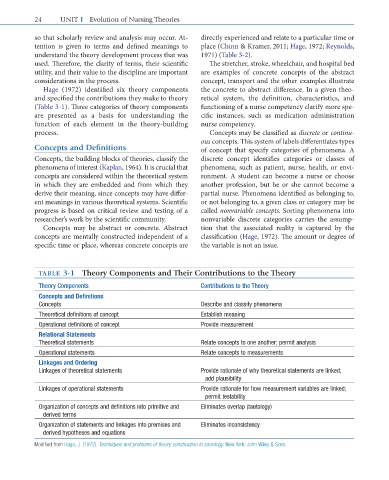
             Hage  (1972)  identified  six  theory  components   the concrete to abstract difference. In a given theo-
           and specified the contributions they make to theory   retical  system,  the  definition,  characteristics,  and
           (Table 3-1). Three categories of theory components   functioning of a nurse competency clarify more spe-
           are  presented  as  a  basis  for  understanding  the    cific  instances,  such  as  medication  administration
           function  of  each  element  in  the  theory-building   nurse competency.
           process.                                        Concepts may be classified as discrete or continu-
                                                         ous concepts. This system of labels differentiates types
           Concepts and Definitions                      of concept that specify categories of phenomena. A
           Concepts, the building blocks of theories, classify the   discrete  concept  identifies  categories  or  classes  of
           phenomena of interest (Kaplan, 1964). It is crucial that   phenomena, such as patient, nurse, health, or envi-
           concepts are considered within the theoretical system   ronment.  A  student  can  become  a  nurse  or  choose
           in  which  they  are  embedded  and  from  which  they   another  profession,  but  he  or  she  cannot  become  a
           derive their meaning, since concepts may have differ-  partial nurse. Phenomena identified as belonging to,
           ent meanings in various theoretical systems. Scientific   or not belonging to, a given class or category may be
           progress is based on critical review and testing of a   called nonvariable concepts. Sorting phenomena into
           researcher’s work by the scientific community.  nonvariable  discrete  categories  carries  the  assump-
             Concepts  may  be  abstract  or  concrete.  Abstract   tion  that  the  associated  reality  is  captured  by  the
           concepts are mentally constructed independent of a   classification (Hage, 1972). The amount or degree of
           specific time or place, whereas concrete concepts are   the variable is not an issue.


            TABLE 3-1   Theory Components and Their Contributions to the Theory

            Theory Components                            Contributions to the Theory
            Concepts and Definitions
            Concepts                                     Describe and classify phenomena
            Theoretical definitions of concept           Establish meaning
            Operational definitions of concept           Provide measurement
            Relational Statements
            Theoretical statements                       Relate concepts to one another; permit analysis
            Operational statements                       Relate concepts to measurements
            Linkages and Ordering
            Linkages of theoretical statements           Provide rationale of why theoretical statements are linked;
                                                          add plausibility
            Linkages of operational statements           Provide rationale for how measurement variables are linked;
                                                          permit testability
            Organization of concepts and definitions into primitive and   Eliminates overlap (tautology)
             derived terms
            Organization of statements and linkages into premises and   Eliminates inconsistency
             derived hypotheses and equations
           Modified from Hage, J. (1972). Techniques and problems of theory construction in sociology. New York: John Wiley & Sons.

