


Page 676 - alligood 8th edition_Neat
P. 676
33

                                                                             CHAP TER


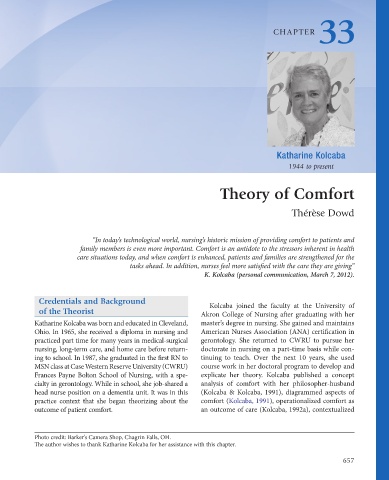
                                                                              Katharine Kolcaba
                                                                                 1944 to present


                                                              Theory of Comfort


                                                                                  Thérèse Dowd


                           “In today’s technological world, nursing’s historic mission of providing comfort to patients and
                       family members is even more important. Comfort is an antidote to the stressors inherent in health
                      care situations today, and when comfort is enhanced, patients and families are strengthened for the
                                     tasks ahead. In addition, nurses feel more satisfied with the care they are giving”
                                                          K. Kolcaba (personal communication, March 7, 2012).


            Credentials and Background                     Kolcaba  joined  the  faculty  at  the  University  of
            of the Theorist                              Akron College of Nursing after graduating with her
           Katharine Kolcaba was born and educated in Cleveland,   master’s degree in nursing. She gained and maintains
           Ohio. In 1965, she received a diploma in nursing and   American Nurses Association (ANA) certification in
           practiced part time for many years in medical-surgical   gerontology.  She  returned  to  CWRU  to  pursue  her
           nursing, long-term care, and home care before return-  doctorate in nursing on a part-time basis while con-
           ing to school. In 1987, she graduated in the first RN to   tinuing  to  teach.  Over  the  next  10  years,  she  used
           MSN class at Case Western Reserve University (CWRU)   course work in her doctoral program to develop and
           Frances Payne Bolton School of Nursing, with a spe-  explicate  her  theory.  Kolcaba  published  a  concept
           cialty in gerontology. While in school, she job-shared a   analysis  of  comfort  with  her  philosopher-husband
           head nurse position on a dementia unit. It was in this   (Kolcaba  &  Kolcaba,  1991),  diagrammed  aspects  of
           practice  context  that  she  began  theorizing  about  the   comfort (Kolcaba, 1991), operationalized comfort as
           outcome of patient comfort.                   an outcome of care (Kolcaba, 1992a), contextualized


           Photo credit: Barker’s Camera Shop, Chagrin Falls, OH.
           The author wishes to thank Katharine Kolcaba for her assistance with this chapter.

                                                                                                657

