


Page 678 - alligood 8th edition_Neat
P. 678
CHAPTER 33  Katharine Kolcaba  659

                                                       Type of Comfort
                                            Relief        Ease       Transcendence


                          Physical
                        Context in Which Comfort Occurs   Psychospiritual


                          Environmental


                          Social


                      Type of Comfort:
                      Relief:  The state of a patient who has had a specific need met
                      Ease:  The state of calm or contentment
                      Transcendence:  The state in which one rises above one’s problems or pain
                      Context in Which Comfort Occurs:
                      Physical:  Pertaining to bodily sensations
                      Psychospiritual:  Pertaining to internal awareness of self, including esteem, concept, sexuality,
                                    and meaning in one’s life; one’s relationship to a higher order or being
                      Environmental:  Pertaining to the external surroundings, conditions, and influences
                      Social:  Pertaining to interpersonal, family, and societal relationships
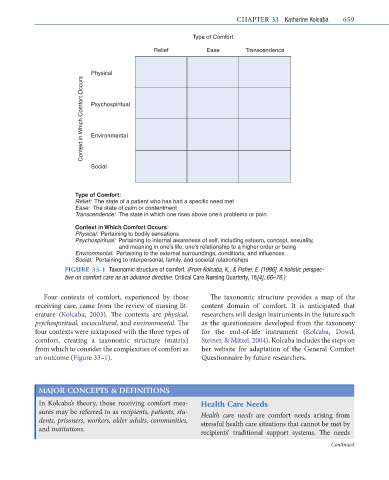
                   FIGURE 33-1   Taxonomic structure of comfort. (From Kolcaba, K., & Fisher, E. [1996]. A holistic perspec-
                   tive on comfort care as an advance directive. Critical Care Nursing Quarterly, 18[4], 66–76.)


             Four  contexts  of  comfort,  experienced  by  those   The  taxonomic  structure  provides  a  map  of  the
           receiving care, came from the review of nursing lit-  content  domain  of  comfort.  It  is  anticipated  that
           erature  (Kolcaba,  2003).  The  contexts  are  physical,   researchers will design instruments in the future such
           psychospiritual, sociocultural, and environmental. The   as  the  questionnaire  developed  from  the  taxonomy
           four contexts were juxtaposed with the three types of   for  the  end-of-life  instrument  (Kolcaba,  Dowd,
           comfort,  creating  a  taxonomic  structure  (matrix)   Steiner, & Mitzel, 2004). Kolcaba includes the steps on
           from which to consider the complexities of comfort as   her  website  for  adaptation  of  the  General  Comfort
           an outcome (Figure 33–1).                     Questionnaire by future researchers.


            MAJOR CONCEPTS & DEFINITIONS
            In  Kolcaba’s  theory,  those  receiving  comfort  mea-  Health Care Needs
            sures may be referred to as recipients, patients, stu-  Health  care  needs  are  comfort  needs  arising  from
            dents, prisoners, workers, older adults, communities,   stressful health care situations that cannot be met by
            and institutions.                            recipients’  traditional  support  systems.  The  needs
                                                                                             Continued

