


Page 406 - Year 3 SOW (2020)
P. 406
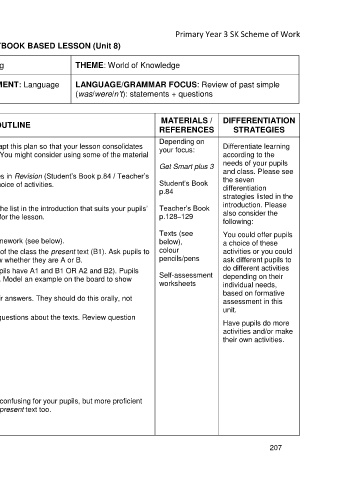
Primary Year 3 SK Scheme of Work
 SCHEME OF WORK: NON-TEXTBOOK BASED LESSON (Unit 8)

 LESSON: 128 (Language Awareness 7)   MAIN SKILL FOCUS: Reading   THEME: World of Knowledge
 WEEK:    TOPIC: Where were you yesterday?   CROSS-CURRICULAR ELEMENT: Language   LANGUAGE/GRAMMAR FOCUS: Review of past simple


                    (was/were/n’t): statements + questions

 CONTENT   LEARNING   LEARNING OUTLINE   MATERIALS /    DIFFERENTIATION
 STANDARD   STANDARD                     REFERENCES        STRATEGIES
                                         Depending on
 Main Skill   Main Skill   Use your notes made on pupils during this unit to adapt this plan so that your lesson consolidates   your focus:   Differentiate learning
 Reading 3.2   Reading 3.2.2    and extends language areas needed by your pupils. You might consider using some of the material      according to the
 Understand a   Understand   as a homework task, if appropriate.   Get Smart plus 3   needs of your pupils
 variety of linear   specific   Note: You could also make use of the review activities in Revision (Student’s Book p.84 / Teacher’s      and class. Please see
 and non-linear   information and   Book p.128–129) and/or consider offering pupils a choice of activities.   Student’s Book   the seven
 print and digital   details of short    p.84           differentiation
 texts by using   simple texts   Pre-lesson             strategies listed in the
 appropriate      1.  Choose an appropriate pre-lesson activity from the list in the introduction that suits your pupils’   Teacher’s Book   introduction. Please
 reading      needs and interests and that will prepare pupils for the lesson.   p.128–129   also consider the
 strategies   Complementary                             following:
    Skill   Lesson delivery              Texts (see     You could offer pupils
    Listening 1.2.5   2.  Pre-teach key vocabulary for the texts about homework (see below).   below),   a choice of these
 Complementary  Understand a   3.  Give half of the class the past text (A1) and half of the class the present text (B1). Ask pupils to   colour   activities or you could
 Skill   wide range of   tell you which one they have, to check they know whether they are A or B.   pencils/pens   ask different pupils to
 Listening 1.2   short supported   4.  Give pupils the gapped texts (A2, B2, so that pupils have A1 and B1 OR A2 and B2). Pupils      do different activities
 Understand   questions   should fill in the texts with the correct form of be. Model an example on the board to show   Self-assessment   depending on their
 meaning in a   pupils what to do.       worksheets     individual needs,
 variety of familiar                                    based on formative
 contexts      5.  Pair pupils, A with B, and ask them to check their answers. They should do this orally, not   assessment in this
    show each other the answers.                        unit.
    6.  With their new partner, pupils write at least two questions about the texts. Review question
 forms before they begin as necessary, e.g.             Have pupils do more
                                                        activities and/or make
 Was there internet?                                    their own activities.
 Were there any computers?
 Were there any books?
 Are children at the library often?
 Are there any computers?
 How is it at home?
 You could focus on the past text only if it is less confusing for your pupils, but more proficient
 pupils may be able to work on questions for the present text too.
 7.  Pairs ask another pair their questions.
 Post-lesson

                                                                    207

