


Page 104 - Class-11-Physics-Part-1_Neat
P. 104
90                                                                                     PHYSICS

                       5.2  ARISTOTLE’S  FALLACY                        true law of nature for forces and motion, one has
                                                                        to imagine a world in which uniform motion is
                       The question posed above appears to be simple.
                       However, it took ages to answer it. Indeed, the  possible with no frictional forces opposing. This
                       correct answer to this question given by Galileo  is what Galileo did.
                       in the seventeenth century was the foundation    5.3  THE LAW OF INERTIA
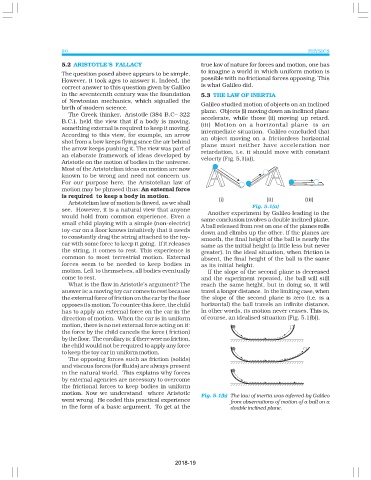
                       of Newtonian mechanics, which signalled the      Galileo studied motion of objects on an inclined
                       birth of modern science.                         plane.  Objects (i) moving down an inclined plane
                         The Greek thinker,  Aristotle (384 B.C– 322
                       B.C.), held the view that if a body is moving,   accelerate, while those (ii) moving up retard.
                                                                                                                is an
                                                                                            horizontal
                                                                                                        plane
                                                                        (iii)
                                                                                         a
                                                                             Motion
                                                                                      on
                       something external is required to keep it moving.  intermediate situation.  Galileo concluded that
                       According to this view, for example, an arrow    an object moving on a frictionless horizontal
                       shot from a bow keeps flying since the air behind  plane must neither have acceleration nor
                       the arrow keeps pushing it. The view was part of  retardation, i.e. it should move with constant
                       an elaborate framework of ideas developed by     velocity (Fig. 5.1(a)).
                       Aristotle on the motion of bodies in the universe.
                       Most of the Aristotelian ideas on motion are now
                       known to be wrong and need not concern us.
                       For our purpose here, the Aristotelian law of
                       motion may be phrased thus: An external force
                       is required  to keep a body in motion.                  (i)             (ii)          (iii)
                         Aristotelian law of motion is flawed, as we shall
                                                                                          Fig. 5.1(a)
                       see.  However, it is a natural view that anyone     Another experiment by Galileo leading to the
                       would hold from common experience. Even a        same conclusion involves a double inclined plane.
                       small child playing with a simple (non-electric)  A ball released from rest on one of the planes rolls
                       toy-car on a floor knows intuitively that it needs  down and climbs up the other. If the planes are
                       to constantly drag the string attached to the toy-  smooth, the final height of the ball is nearly the
                       car with some force to keep it going.  If it releases  same as the initial height (a little less but never
                       the string, it comes to rest. This experience is  greater). In the ideal situation, when friction is
                       common to most terrestrial motion. External      absent, the final height of the ball is the same
                       forces seem to be needed to keep bodies in       as its initial height.
                       motion. Left to themselves, all bodies eventually   If the slope of the second plane is decreased
                       come to rest.                                    and the experiment repeated, the ball will still
                         What is the flaw in Aristotle’s argument? The  reach the same height, but in doing so,  it will
                       answer is: a moving toy car comes to rest because  travel a longer distance.  In the limiting case, when
                       the external force of friction on the car by the floor  the slope of the second plane is zero (i.e. is a
                       opposes its motion. To counter this force, the child  horizontal) the ball travels an infinite distance.
                       has to apply an external force on the car in the  In other words, its motion never ceases. This is,
                       direction of motion.  When the car is in uniform  of course, an idealised situation (Fig. 5.1(b)).
                       motion, there is no net external force acting on it:
                       the force by the child cancels the force ( friction)
                       by the floor.  The corollary is: if there were no friction,
                       the child would not be required to apply any force
                       to keep the toy car in uniform motion.
                         The opposing forces such as friction (solids)
                       and viscous forces (for fluids) are always present
                       in the natural world.  This explains why forces
                       by external agencies are necessary to overcome
                       the frictional forces to keep bodies in uniform
                       motion. Now we understand     where Aristotle    Fig. 5.1(b) The law of inertia was inferred by Galileo
                       went wrong.  He coded this practical experience             from observations of motion of a ball on a
                       in the form of a basic argument.  To get at the             double inclined plane.


                                                               2018-19

