


Page 108 - Class-11-Physics-Part-1_Neat
P. 108
94                                                                                     PHYSICS

                         this hurts. The conclusion is clear: force not    This force is provided by our hand through
                         only depends on the change in momentum,           the string.  Experience suggests that our hand
                         but also on how fast the change is brought        needs to exert a greater force if the stone is
                         about.   The same change in momentum              rotated at greater speed or in a circle of
                         brought about in a shorter time needs a           smaller radius, or both. This corresponds to
                         greater applied force. In short, the greater the  greater acceleration or equivalently a greater
                         rate of change of momentum, the greater is        rate of change in momentum vector. This
                         the force.                                        suggests that the greater the rate of change
                                                                           in momentum vector the greater is the force
                                                                           applied.


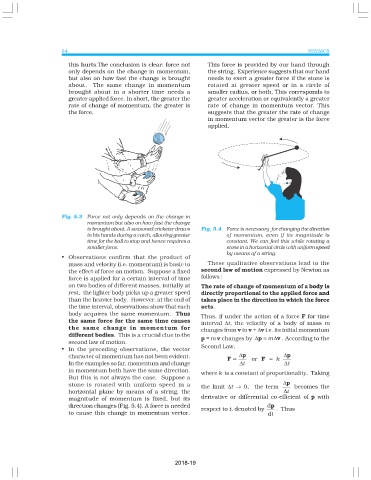
                       Fig. 5.3 Force not only depends on the change in
                                momentum but also on how fast the change
                                is brought about. A seasoned cricketer draws  Fig. 5.4 Force is necessary  for changing the direction
                                in his hands during a catch, allowing greater    of momentum, even if its magnitude is
                                time for the ball to stop and hence requires a   constant. We can feel this while rotating a
                                smaller force.                                   stone in a horizontal circle with uniform speed
                                                                                 by means of a string.
                       • Observations confirm that the product of
                         mass and velocity (i.e. momentum) is basic to     These qualitative observations lead to the
                         the effect of force on motion.  Suppose a fixed  second law of motion expressed by Newton as
                         force is applied for a certain interval of time  follows :
                         on two bodies of different masses, initially at  The rate of change of momentum of a body is
                         rest,  the lighter body picks up a greater speed  directly proportional to the applied force and
                         than the heavier body.  However, at the end of  takes place in the direction in which the force
                         the time interval, observations show that each  acts.
                         body acquires the same momentum.  Thus
                                                                        Thus, if under the action of a force F for time
                         the same force for the same time causes
                                                                        interval ∆t, the velocity of a body of mass m
                         the same change in momentum for
                                                                        changes from v to v + ∆v i.e. its initial momentum
                         different bodies.  This is a crucial clue to the  p = m v changes by ∆ =p  m∆v . According to the
                         second law of motion.
                                                                        Second Law,
                       • In the preceding observations, the vector
                         character of momentum has not been evident.                   F  ∝  ∆p    or     =F       ∆p
                                                                                                   k
                         In the examples so far, momentum and change                   t ∆             t ∆
                         in momentum both have the same direction.
                                                                        where k  is a constant of proportionality.  Taking
                         But this is not always the case.  Suppose a
                         stone is rotated with uniform speed in a                                    ∆p
                                                                        the limit ∆t →  0,  the term     becomes the
                         horizontal plane by means of a string, the                                    t ∆
                         magnitude of momentum is fixed, but its        derivative or differential co-efficient of p  with
                         direction changes (Fig. 5.4). A force is needed                        dp
                                                                        respect to t, denoted by   .  Thus
                         to cause this change in momentum vector.                               dt


                                                               2018-19

