


Page 106 - Class-11-Physics-Part-1_Neat
P. 106
92                                                                                     PHYSICS

                                                Galileo Galilei (1564 - 1642)

                         Galileo Galilei, born in Pisa, Italy in 1564 was a key figure in the scientific revolution
                         in Europe about four centuries ago.  Galileo proposed the concept of acceleration.
                         From experiments on motion of bodies on inclined planes or falling freely, he
                         contradicted the Aristotelian notion that a force was required to keep a body in
                         motion, and that heavier bodies fall faster than lighter bodies under gravity.  He
                         thus arrived at the law of inertia that was the starting point of the subsequent
                         epochal work of Isaac Newton.
                             Galileo’s discoveries in astronomy were equally revolutionary.  In 1609, he designed
                         his own telescope (invented earlier in Holland) and used it to make a number of
                         startling  observations :  mountains  and depressions on  the  surface of the moon;
                         dark spots on the sun; the moons of Jupiter and the phases of Venus.  He concluded
                         that the Milky Way derived its luminosity because of a large number of stars not visible to the naked eye.
                         In his masterpiece of scientific reasoning : Dialogue on the Two Chief World Systems, Galileo advocated
                         the heliocentric theory of the solar system proposed by Copernicus, which eventually got universal
                         acceptance.
                             With Galileo came a turning point in the very method of scientific inquiry. Science was no longer
                         merely observations of nature and inferences from them. Science meant devising and doing experiments
                         to verify or refute theories. Science meant measurement of quantities and a search for mathematical
                         relations between them. Not undeservedly, many regard Galileo as the father of modern science.


                         More often, however, we do not know all the    normal force R  must be equal and opposite to the
                       forces to begin with.  In that case, if we know  weight W ”.
                       that an object is unaccelerated (i.e. it is either
                       at rest or in uniform linear motion), we can infer
                       from the first law that the net external force on
                       the object must be zero. Gravity is everywhere.
                       For terrestrial phenomena, in particular, every
                       object experiences gravitational force due to the
                       earth.  Also objects in motion generally experience
                       friction, viscous drag, etc. If then, on earth, an
                       object is at rest or in uniform linear motion, it is
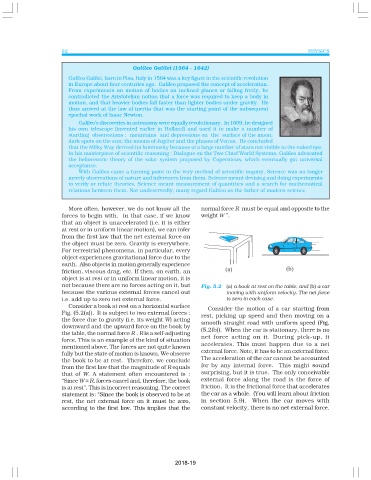
                       not because there are no forces acting on it, but  Fig. 5.2 (a) a book at rest on the table, and (b) a car
                       because the various external forces cancel out            moving with uniform velocity. The net force
                       i.e. add up to zero net external force.                   is zero in each case.
                         Consider a book at rest on a horizontal surface   Consider the motion of a car starting from
                       Fig. (5.2(a)).  It is subject to two external forces :  rest, picking up speed and then moving on a
                       the force due to gravity (i.e. its weight W) acting  smooth straight road with uniform speed (Fig.
                       downward and the upward force on the book by     (5.2(b)).  When the car is stationary, there is no
                       the table, the normal force R . R is a self-adjusting
                       force. This is an example of the kind of situation  net force acting on it. During pick-up, it
                       mentioned above. The forces are not quite known  accelerates. This must happen due to a net
                       fully but the state of motion is known. We observe  external force. Note, it has to be an external force.
                       the book to be at rest.  Therefore, we conclude  The acceleration of the car cannot be accounted
                       from the first law that the magnitude of R equals  for by any internal force.  This might sound
                       that of W. A statement often encountered is  :   surprising, but it is true.  The only conceivable
                       “Since W = R, forces cancel and, therefore, the book  external force along the road is the force of
                       is at rest”. This is incorrect reasoning. The correct  friction.  It is the frictional force that accelerates
                       statement is : “Since the book is observed to be at  the car as a whole.  (You will learn about friction
                       rest, the net external force on it must be zero,  in section 5.9).  When the car moves with
                       according to the first law. This implies that the  constant velocity, there is no net external force.


                                                               2018-19

