


Page 109 - Class-11-Physics-Part-1_Neat
P. 109
LAWS OF MOTION                                                                              95

                               dp                                  on the particle and a stands for acceleration
                            F  =  k                      (5.2)     of the particle. It turns out, however, that the
                               dt
                For a body of fixed mass m,                        law in the same form applies to a rigid body or,
                                                                   even more generally, to a system of particles.
                        dp     d            dv                     In that case, F refers to the total external force
                            =    (m v ) =  m    =  m a       (5.3)  on the system and a refers to the acceleration
                        dt    dt            dt
                                                                   of the system as a whole.  More precisely, a is
                i.e the Second Law can also be written as          the acceleration of the centre of mass of the
                             F  =   k m a                   (5.4)
                                                                   system about which we shall study in detail in
                which shows that force is proportional to the      chapter 7. Any internal forces in the system
                product of mass m and acceleration a.              are not to be included in F.
                  The unit of force has not been defined so far.
                In fact, we use Eq. (5.4) to define the unit of force.
                We, therefore, have the liberty to choose any
                constant value for k.  For simplicity, we choose
                k = 1. The second law then is

                          d p
                      F       =    m  a                  (5.5)
                        =
                           t d
                In SI unit force is one that causes an acceleration
                       -2
                of 1 m s  to a mass of 1 kg. This unit is known as
                newton : 1 N = 1 kg m s .
                                      -2
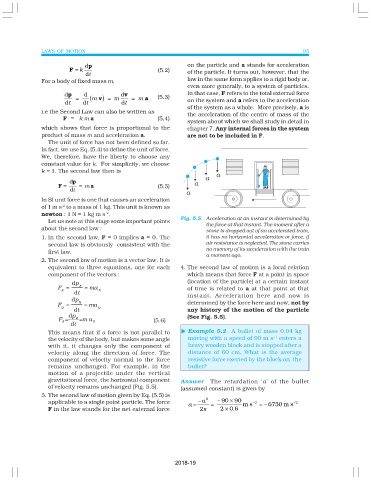
                                                                 Fig. 5.5  Acceleration at an instant is determined by
                  Let us note at this stage some important points
                                                                          the force at that instant. The moment after a
                about the second law :                                    stone is dropped out of an accelerated train,
                1. In the second law, F = 0 implies a = 0. The            it has no horizontal acceleration or force, if
                  second law is obviously  consistent with the            air resistance is neglected. The stone carries
                                                                          no memory of its acceleration with the train
                  first law.
                                                                          a moment ago.
                2. The second law of motion is a vector law. It is
                  equivalent to three equations, one for each    4. The second law of motion is a local relation
                  component of the vectors :                       which means that force F at a point in space
                          d p x                                    (location of the particle) at a certain instant
                     F =       =  ma                               of time is related to a  at that point at that
                       x            x
                             t d
                                                                   instant. Acceleration here and now is
                          d p y
                     F =       =  ma  y                            determined by the force here and now, not by
                       y
                            t d                                    any history of the motion of the particle
                         d p z                                     (See Fig. 5.5).
                      F =    = m  a
                       z          z                                   (5.6)
                           t d
                  This means that if a force is not parallel to    t  Example 5.2  A bullet of mass 0.04 kg
                                                                                                  –1
                  the velocity of the body, but makes some angle    moving with a speed of 90 m s  enters a
                  with it, it changes only the component of         heavy wooden block and is stopped after a
                  velocity along the direction of force. The        distance of 60 cm. What is the average
                  component of velocity normal to the force         resistive force exerted by the block on  the
                  remains unchanged. For example, in the            bullet?
                  motion of a projectile under the vertical
                  gravitational force, the horizontal component  Answer     The retardation ‘a’ of the bullet
                  of velocity remains unchanged (Fig. 5.5).      (assumed constant) is given by
                3. The second law of motion given by Eq. (5.5) is         2
                  applicable to a single point particle. The force  a =  – u  =   – 90 ×  90  m s − 2  =  – 6750 m s − 2
                  F in the law stands for the net external force        2s     2 ×  0.6


                                                               2018-19

