


Page 130 - Class-11-Physics-Part-1_Neat
P. 130
116                                                                                    PHYSICS

                       6.2 NOTIONS OF WORK AND KINETIC
                            ENERGY: THE WORK-ENERGY THEOREM                to be proportional to the speed of the drop
                                                                           but is otherwise undetermined.  Consider
                       The following relation for rectilinear motion under  a drop of mass 1.00 g falling from a height
                       constant acceleration a has been encountered        1.00 km.  It hits the ground with a speed of
                       in Chapter 3,                                       50.0 m s .  (a) What is the work done by the
                                                                                   -1
                                  2
                              2
                               v  − u  = 2 as                   (6.2)      gravitational force ? What is the work done
                       where u and v  are the initial and final speeds     by the unknown resistive force?
                       and s the distance traversed.  Multiplying both  Answer (a) The change in kinetic energy of the
                       sides by m/2, we have
                                                                        drop is
                             1       1                                                   1
                                  2
                               mv −   mu =   mas =  Fs         (6.2a)               ∆ K =  m v −  0
                                                                                              2
                                          2
                             2       2                                                   2
                       where the last step follows from Newton’s Second             =  1  ×  -3  ×  ×
                       Law. We can generalise Eq. (6.2) to three                      2  10    50 50
                       dimensions by employing vectors                              = 1.25 J
                              v − u = 2 a.d                             where we have assumed that the drop is initially
                                   2
                               2
                                                                        at rest.
                       Here a and d are acceleration and displacement
                                                                           Assuming that g is a constant with a value
                       vectors of the object respectively.                     2
                                                                        10 m/s , the work done by the gravitational force
                       Once again multiplying both sides by m/2 , we obtain
                                                                        is,
                               1      1
                                mv −    mu =  m a.d  = F.d     (6.2b)          W = mgh
                                   2
                                           2
                                                                                 g
                               2      2                                              = 10  ×10 ×10 3
                                                                                       -3
                         The above equation provides a motivation for                = 10.0 J
                       the definitions of work and kinetic energy. The  (b) From the work-energy theorem
                       left side of the equation is the difference in the
                                                                                  =


                       quantity ‘half the mass times the square of the        ∆ K   W +  W r
                                                                                      g
                       speed’ from its initial value to its final value. We  where W   is the work done by the resistive force
                                                                                r
                       call each of these quantities the ‘kinetic energy’,  on the raindrop.  Thus
                       denoted by K. The right side is a product of the        W  = ∆K − W
                                                                                 r         g
                       displacement and the component of the force                  = 1.25 −10
                       along the displacement.  This quantity is called              = − 8.75 J
                       ‘work’ and is denoted by W.  Eq. (6.2b) is then
                                                                        is negative.                                t
                              K −  K = W                        (6.3)
                                f   i                                   6.3  WORK
                       where K   and K   are respectively the initial and  As seen earlier, work is related to force and the
                               i      f
                       final kinetic energies of the object. Work refers  displacement over which it acts.  Consider a
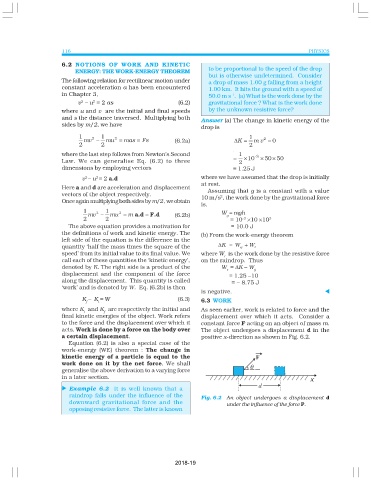
                       to the force and the displacement over which it  constant force F acting on an object of mass m.
                       acts. Work is done by a force on the body over   The object undergoes a displacement d in the
                       a certain displacement.                          positive x-direction as shown in Fig. 6.2.
                         Equation (6.2) is also a special case of the
                       work-energy (WE) theorem : The change in
                       kinetic energy of a particle is equal to the
                       work done on it by the net force. We shall
                       generalise the above derivation to a varying force
                       in a later section.
                         t  Example 6.2  It is well known that a
                          raindrop falls under the influence of the     Fig. 6.2 An object undergoes a displacement d
                          downward gravitational force and the                   under the influence of the force F.
                          opposing resistive force.  The latter is known


                                                               2018-19

