


Page 129 - Class-11-Physics-Part-1_Neat
P. 129
WORK, ENERGY AND POWER 115
A dot B) is defined as
A = A i + A j + A k
.
A B = A B cos θ (6.1a) x y z
B = B i + B j + B k
where θ is the angle between the two vectors as x y z
shown in Fig. 6.1(a). Since A, B and cos θ are their scalar product is
scalars, the dot product of A and B is a scalar A B = ( A i ˆ + A j ˆ + A k ) ( B i ˆ + B j + B k )
ˆ .
ˆ
.
ˆ
quantity. Each vector, A and B, has a direction x y z x y z
but their scalar product does not have a = A B x + A B y + A B z (6.1b)
y
z
x
direction.
From the definition of scalar product and
From Eq. (6.1a), we have (Eq. 6.1b) we have :
. .. .
.
A B = A (B cos θ ) ( i ) A A = A A + A A + A A z
y
x
y
x
z
2
2
2
= B (A cos θ ) Or, A = A + A + A 2 (6.1c)
x y z
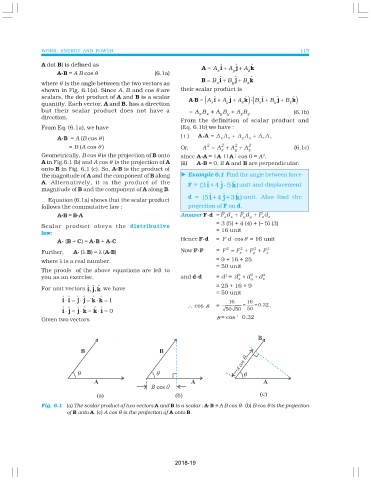
Geometrically, B cos θ is the projection of B onto since A . A = |A ||A| cos 0 = A .
2
A in Fig.6.1 (b) and A cos θ is the projection of A (ii) A . B = 0, if A and B are perpendicular.
.
onto B in Fig. 6.1 (c). So, A B is the product of
the magnitude of A and the component of B along u Example 6.1 Find the angle between force
A. Alternatively, it is the product of the F = (3 + 4 -5 )i ˆ j k
ˆ
ˆ unit and displacement
magnitude of B and the component of A along B.
ˆ
ˆ unit. Also find the
d = (5 + 4 +3 )i ˆ j k
Equation (6.1a) shows that the scalar product
follows the commutative law : projection of F on d.
.
.
.
A B = B A Answer F d = F d + F d + F d z
z
y
y
x
x
= 3 (5) + 4 (4) + (– 5) (3)
Scalar product obeys the distributive
law: = 16 unit
Hence F . d = F d cosθ = 16 unit
A . (B + C) = A . B + A . C
.
+
2
2
Further, A . (λ B) = λ (A . B) Now F F = F = F x 2 F + F z 2
y
where λ is a real number. = 9 + 16 + 25
= 50 unit
The proofs of the above equations are left to
.
+
2
2
you as an exercise. and d d = d = d 2 x d + d z 2
y
For unit vectors i, j,k we have = 25 + 16 + 9
= 50 unit
⋅
j j =
⋅
⋅
i i = k k = 1 16 16
∴ cos θ = = = 0.32 ,
i j = k i = 0 50 50 50
j k =
⋅
⋅
⋅
–1
Given two vectors θ = cos 0.32
.
Fig. 6.1 (a) The scalar product of two vectors A and B is a scalar : A B = A B cos θ. (b) B cos θ is the projection
of B onto A. (c) A cos θ is the projection of A onto B.
2018-19

