


Page 151 - Class-11-Physics-Part-1_Neat
P. 151
WORK, ENERGY AND POWER                                                                     137

                                                                   o
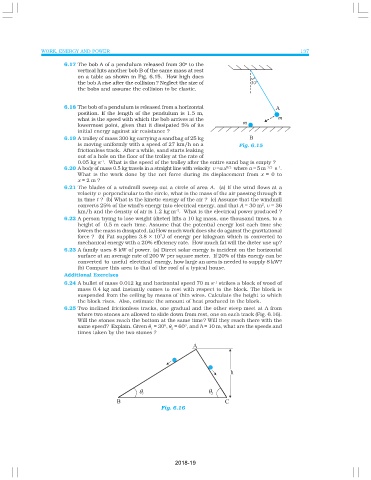
                        6.17 The bob A of a pendulum released from 30  to the
                             vertical hits another bob B of the same mass at rest
                             on a table as shown in Fig. 6.15.  How high does
                             the bob A rise after the collision ? Neglect the size of
                             the bobs and assume the collision to be elastic.


                        6.18 The bob of a pendulum is released from a horizontal
                             position. If the length of the pendulum is 1.5 m,
                             what is the speed with which the bob arrives at the
                             lowermost point, given that it dissipated 5% of its
                             initial energy against air resistance ?
                        6.19 A trolley of mass 300 kg carrying a sandbag of 25 kg
                             is moving uniformly with a speed of 27 km/h on a         Fig. 6.15
                             frictionless track.  After a while, sand starts leaking
                             out of a hole on the floor of the trolley at the rate of
                                     –1
                             0.05 kg s .  What is the speed of the trolley after the entire sand bag is empty ?
                                                                                 3/2
                                                                                                   –1
                        6.20 A body of mass 0.5 kg travels in a straight line with velocity  v =a x   where a = 5 m –1/2   s .
                             What is the work done by the net force during its displacement from x = 0 to
                             x = 2 m ?
                        6.21 The blades of a windmill sweep out a circle of area A.  (a) If the wind flows at a
                             velocity v  perpendicular to the circle, what is the mass of the air passing through it
                             in time t ?  (b) What is the kinetic energy of the air ?  (c) Assume that the windmill
                                                                                              2
                             converts 25% of the wind’s energy into electrical energy, and that A = 30 m , v = 36
                                                               –3
                             km/h and the density of air is 1.2 kg m .  What is the electrical power produced ?
                        6.22 A person trying to lose weight (dieter) lifts a 10 kg mass, one thousand times, to a
                             height of  0.5 m each time. Assume that the potential energy lost each time she
                             lowers the mass is dissipated. (a) How much work does she do against the gravitational
                                                          7
                             force ?  (b) Fat supplies 3.8 × 10 J of energy per kilogram which is converted to
                             mechanical energy with a 20% efficiency rate.  How much fat will the dieter use up?
                        6.23 A family uses 8 kW of power. (a) Direct solar energy is incident on the horizontal
                             surface at an average rate of 200 W per square meter.  If 20% of this energy can be
                             converted  to  useful  electrical  energy, how large an area is needed to supply 8 kW?
                             (b) Compare this area to that of the roof of a typical house.
                        Additional Exercises
                                                                             –1
                        6.24 A bullet of mass 0.012 kg and horizontal speed 70 m s  strikes a block of wood of
                             mass 0.4 kg and instantly comes to rest with respect to the block. The block is
                             suspended from the ceiling by means of thin wires. Calculate the height to which
                             the block rises.  Also, estimate the amount of heat produced in the block.
                        6.25 Two inclined frictionless tracks, one gradual and the other steep meet at A from
                             where two stones are allowed to slide down from rest, one on each track (Fig. 6.16).
                             Will the stones reach the bottom at the same time? Will they reach there with the
                                                                  0
                                                           0
                             same speed?  Explain. Given θ  = 30 , θ  = 60 , and h = 10 m, what are the speeds and
                                                      1       2
                             times taken by the two stones ?


                                                          Fig. 6.16


                                                               2018-19

