


Page 154 - Class-11-Physics-Part-1_Neat
P. 154
140                                                                                    PHYSICS

                                            APPENDIX 6.1 : POWER CONSUMPTION IN WALKING

                       The table below lists the approximate power expended by an adult human of mass 60 kg.

                       Table 6.4 Approximate power consumption
                                                              Mechanical work must not be confused with the everyday usage
                                                              of the term work.  A woman standing with a very heavy load on
                                                              her head may get very tired.  But no mechanical work is involved.
                                                              That is not to say that mechanical work cannot be estimated in
                                                              ordinary human activity.
                       Consider a person walking with constant speed v . The mechanical work he does may be estimated simply
                                                                   0
                       with the help of the work-energy theorem. Assume :
                       (a) The major work done in walking is due to the acceleration and deceleration of the legs with each stride
                          (See Fig. 6.20).
                       (b) Neglect air resistance.
                       (c) Neglect the small work done in lifting the legs against gravity.
                       (d) Neglect the swinging of hands etc. as is common in walking.
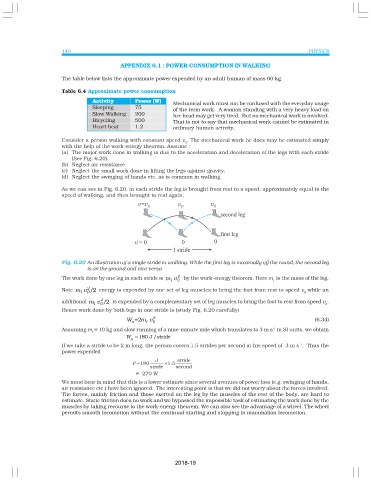
                       As we can see in Fig. 6.20, in each stride the leg is brought from rest to a speed, approximately equal to the
                       speed of walking, and then brought to rest again.


                       Fig. 6.20 An illustration of a single stride in walking. While the first leg is maximally off the round, the second leg
                                is on the ground and vice-versa
                       The work done by one leg in each stride is m  v    2    by the work-energy theorem. Here m   is the mass of the leg.
                                                             l  0                                 l
                       Note  m  v    2 / 2  energy is expended by one set of leg muscles to bring the foot from rest to speed v  while an
                              l  0                                                                           0
                       additional m  v    2 / 2   is expended by a complementary set of leg muscles to bring the foot to rest from speed v .
                                  l  0                                                                              0
                       Hence work done by both legs in one stride is (study Fig. 6.20 carefully)
                                              W = 2 m l  v    0 2                                                (6.34)
                                                s
                                                                                                  -1
                       Assuming m  = 10 kg and slow running of a nine-minute mile which translates to 3 m s  in SI units, we obtain
                                  l
                                              W = 180 J /stride
                                               s
                                                                                                           -1
                       If we take a stride to be 2 m long, the person covers 1.5 strides per second at his speed of  3 m s .  Thus the
                       power expended

                                                    =  270 W
                       We must bear in mind that this is a lower estimate since several avenues of power loss (e.g. swinging of hands,
                       air resistance etc.) have been ignored.  The interesting point is that we did not worry about the forces involved.
                       The forces, mainly friction and those exerted on the leg by the muscles of the rest of the body, are hard to
                       estimate. Static friction does no work and we bypassed the impossible task of estimating the work done by the
                       muscles by taking recourse to the work-energy theorem. We can also see the advantage of a wheel. The wheel
                       permits smooth locomotion without the continual starting and stopping in mammalian locomotion.


                                                               2018-19

