


Page 148 - Class-11-Physics-Part-1_Neat
P. 148
134                                                                                    PHYSICS

                                                                 EXERCISES

                               6.1  The sign of work done by a force on a body is important to understand.  State carefully
                                    if the following quantities are positive or negative:
                                    (a) work done by a man in lifting a bucket out of a well by means of a rope tied to the
                                       bucket.
                                    (b) work done by gravitational force in the above case,
                                    (c) work done by friction on a body
                                       sliding down an inclined plane,
                                    (d) work done by an applied force on
                                       a body moving on a rough
                                       horizontal plane with uniform
                                       velocity,
                                    (e) work done by the resistive force of
                                       air on a vibrating pendulum in
                                       bringing it to rest.
                               6.2  A body of mass 2 kg initially at rest
                                    moves under the action of an applied
                                    horizontal force of 7 N on a table with
                                    coefficient of kinetic friction = 0.1.
                                    Compute the
                                    (a) work done by the applied force in
                                       10 s,
                                    (b) work done by friction in 10 s,
                                    (c) work done by the net force on the
                                       body in 10 s,
                                    (d) change in kinetic energy of the
                                       body in 10 s,
                                    and interpret your results.
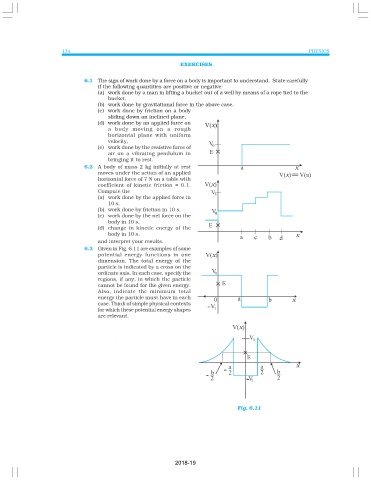
                               6.3  Given in Fig. 6.11 are examples of some
                                    potential energy functions in one
                                    dimension. The total energy of the
                                    particle is indicated by a cross on the
                                    ordinate axis. In each case, specify the
                                    regions, if any, in which the particle
                                    cannot be found for the given energy.
                                    Also, indicate the minimum total
                                    energy the particle must have in each
                                    case. Think of simple physical contexts
                                    for which these potential energy shapes
                                    are relevant.


                                                                                     Fig. 6.11


                                                               2018-19

