


Page 147 - Class-11-Physics-Part-1_Neat
P. 147
WORK, ENERGY AND POWER                                                                     133


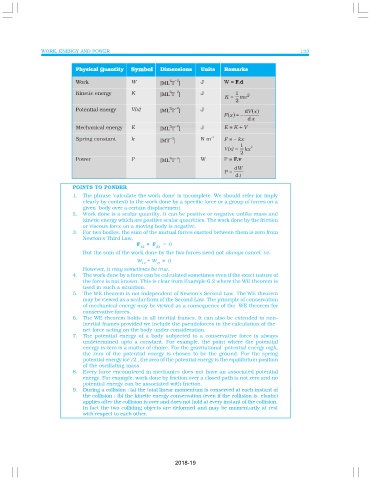
                           POINTS TO PONDER
                           1.  The phrase ‘calculate the work done’ is incomplete. We should refer (or imply
                              clearly by context) to the work done by a specific force or a group of forces on a
                              given  body over a certain displacement.
                           2.  Work done is a scalar quantity. It can be positive or negative unlike mass and
                              kinetic energy which are positive scalar quantities. The work done by the friction
                              or viscous force on a moving body is negative.
                           3.  For two bodies, the sum of the mutual forces exerted between them is zero from
                              Newton’s Third Law,
                                                 F   +  F  =  0
                                                   12    21
                              But the sum of the work done by the two forces need not always cancel, i.e.
                                                 W   + W  ≠  0
                                                   12    21
                              However, it may sometimes be true.
                           4.  The work done by a force can be calculated sometimes even if the exact nature of
                              the force is not known. This is clear from Example 6.2 where the WE theorem is
                              used in such a situation.
                           5.  The WE theorem is not independent of Newton’s Second Law. The WE theorem
                              may be viewed as a scalar form of the Second Law. The principle of conservation
                              of mechanical energy may be viewed as a consequence of the  WE theorem for
                              conservative forces.
                           6.  The WE theorem holds in all inertial frames. It can also be extended to non-
                              inertial frames provided we include the pseudoforces in the calculation of the
                              net force acting on the body under consideration.
                           7.  The potential energy of a body subjected to a conservative force is always
                              undetermined upto a constant. For example, the point where the potential
                              energy is zero is a matter of choice. For the gravitational  potential energy mgh,
                              the zero of the potential energy is chosen to be the ground. For the spring
                                               2
                              potential energy kx /2 , the zero of the potential energy is the equilibrium position
                              of the oscillating mass.
                           8.  Every force encountered in mechanics does not have an associated potential
                              energy. For example, work done by friction over a closed path is not zero and no
                              potential energy can be associated with friction.
                           9.  During a collision : (a) the total linear momentum is conserved at each instant of
                              the collision ; (b) the kinetic energy conservation (even if the collision is  elastic)
                              applies after the collision is over and does not hold at every instant of the collision.
                              In fact the two colliding objects are deformed and may be momentarily at rest
                              with respect to each other.


                                                               2018-19

