


Page 158 - Class-11-Physics-Part-1_Neat
P. 158
144                                                                                    PHYSICS

                       axis of rotation of such a fan has an oscillating  Thus, for us rotation will be about a fixed axis
                       (sidewise) movement in a horizontal plane about  only unless stated otherwise.
                       the vertical through the point at which the axis     The rolling motion of a cylinder down an
                       is pivoted (point O in Fig. 7.5(b)).             inclined plane is a combination of rotation about
                          While the fan rotates and its axis moves      a fixed axis and translation.      Thus, the
                       sidewise, this point is fixed.  Thus, in more    ‘something else’ in the case of rolling motion
                       general cases of rotation, such as the rotation  which we referred to earlier is rotational motion.
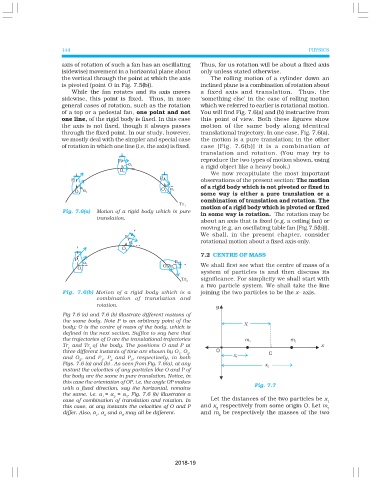
                       of a top or a pedestal fan, one point and not    You will find Fig. 7.6(a) and (b) instructive from
                       one line, of the rigid body is fixed. In this case  this point of view. Both these figures show
                       the axis is not fixed, though it always passes   motion of the same body along identical
                       through the fixed point. In our study, however,  translational trajectory. In one case, Fig. 7.6(a),
                       we mostly deal with the simpler and special case  the motion is a pure translation; in the other
                       of rotation in which one line (i.e. the axis) is fixed.  case [Fig. 7.6(b)] it is a combination of
                                                                        translation and rotation. (You may try to
                                                                        reproduce the two types of motion shown, using
                                                                        a rigid object like a heavy book.)
                                                                            We now recapitulate the most important
                                                                        observations of the present section: The motion
                                                                        of a rigid body which is not pivoted or fixed in
                                                                        some way is either a pure translation or a
                                                                        combination of translation and rotation. The
                                                                        motion of a rigid body which is pivoted or fixed
                       Fig. 7.6(a)  Motion of a rigid body which is pure
                                                                        in some way is rotation.  The rotation may be
                                   translation.
                                                                        about an axis that is fixed (e.g. a ceiling fan) or
                                                                        moving (e.g. an oscillating table fan [Fig.7.5(b)]).
                                                                        We shall, in the present chapter, consider
                                                                        rotational motion about a fixed axis only.

                                                                        7.2  CENTRE OF MASS
                                                                        We shall first see what the centre of mass of a
                                                                        system of particles is and then discuss its
                                                                        significance. For simplicity we shall start with
                                                                        a two particle system. We shall take the line
                       Fig. 7.6(b)  Motion of a rigid body which is a   joining the two particles to be the x- axis.
                                   combination of translation and
                                   rotation.
                       Fig 7.6 (a) and 7.6 (b) illustrate different motions of
                       the same body. Note P is an arbitrary point of the
                       body; O is the centre of mass of the body, which is
                       defined in the next section. Suffice to say here that
                       the trajectories of O are the translational trajectories
                       Tr  and Tr of the body. The positions O and P at
                         1       2
                       three different instants of time are shown by O , O ,
                                                                1  2
                       and O , and P , P  and P , respectively, in both
                             3       1  2      3
                       Figs. 7.6 (a) and (b) . As seen from Fig. 7.6(a), at any
                       instant the velocities of any particles like O and P of
                       the body are the same in pure translation. Notice, in
                       this case the orientation of OP, i.e. the angle OP makes
                                                                                           Fig. 7.7
                       with a fixed direction, say the horizontal, remains
                       the same, i.e. α = α  = α . Fig. 7.6 (b) illustrates a
                                     1   2    3
                       case of combination of translation and rotation. In  Let the distances of the two particles be x 1
                       this case, at any instants the velocities of O and P  and x  respectively from some origin O. Let m 1
                                                                              2
                       differ. Also, α , α  and α  may all be different.  and m  be respectively the masses of the two
                                   1  2     3                                 2


                                                               2018-19

