


Page 159 - Class-11-Physics-Part-1_Neat
P. 159
SYSTEMS OF PARTICLES AND ROTATIONAL MOTION                                                 145

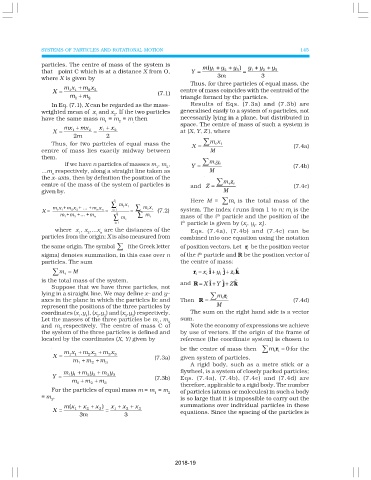
                particles. The centre of mass of the system is           m (y +  y +  y  )  y +  y +  y
                that   point C which is at a distance X from O,      Y =    1   2    3  =  1  2   3
                                                                              3m              3
                where X is given by
                                                                    Thus, for three particles of equal mass, the
                        m x +  m x
                    X =  1 1    2  2                             centre of mass coincides with the centroid of the
                          m +  m                         (7.1)
                            1   2                                triangle formed by the particles.
                   In Eq. (7.1), X can be regarded as the mass-     Results of Eqs. (7.3a) and (7.3b) are
                weighted mean of  x and x . If the two particles  generalised easily to a system of n particles, not
                                   1     2
                have the same mass m  = m  = m then              necessarily lying in a plane, but distributed in
                                      1    2    ,
                        mx +  mx    x +  x                       space. The centre of mass of such a system is
                    X =    1    2  =  1   2                      at (X, Y, Z ), where
                           2m          2
                   Thus, for two particles of equal mass the         X =  ∑ m x i                        (7.4a)
                                                                             i
                centre of mass lies exactly midway between                 M
                them.                                                    ∑
                                                                             i
                           If we have n particles of masses m , m ,  Y =   m y i
                                                        1   2                                            (7.4b)
                ...m  respectively, along a straight line taken as         M
                   n
                the x- axis, then by definition the position of the           ∑
                                                                                  i
                centre of the mass of the system of particles is    and   Z =   m z i                    (7.4c)
                given by.                                                       M
                                         n                          Here M = ∑    m is the total mass of the
                                        ∑  m x                                      i
                    m x + m x + ... + m x    i  i  ∑  m x  i
                                                     i
                X =  1  1  2  2    n  n  =  i= 1  =       (7.2)  system. The index i runs from 1 to n; m  is the
                                                                                                        i
                                          n
                      m + m +... + m  n  ∑  m     ∑  m i         mass of the i  particle and the position of the
                                                                              th
                        1
                           2
                                                                 th
                                          i= 1  i                i  particle is given by (x , y , z ).
                                                                                        i  i  i
                    where  x , x ,...x  are the distances of the    Eqs. (7.4a), (7.4b) and (7.4c) can be
                             1  2   n
                particles from the origin; X is also measured from  combined into one equation using the notation
                the same origin. The symbol ∑ (the Greek letter  of position vectors. Let  r  be the position vector
                                                                                         i
                sigma) denotes summation, in this case over n    of the i  particle and R be the position vector of
                                                                       th
                particles. The sum                               the centre of mass:
                    ∑ m =  M                                          r i  =  x i    +  y j    +  z k

                                                                                    i
                                                                          i
                                                                               i
                        i
                is the total mass of the system.                 and  R  =  X + Y + k


                                                                                  Z
                                                                                j
                                                                           i
                   Suppose that we have three particles, not
                lying in a straight line. We may define x– and y–           ∑ m r
                axes in the plane in which the particles lie and  Then   R  =   i i                      (7.4d)
                represent the positions of the three particles by             M
                coordinates (x ,y ), (x ,y ) and (x ,y ) respectively.  The sum on the right hand side is a vector
                             1  1  2  2      3  3
                Let the masses of the three particles be m , m   sum.
                                                         1   2
                and m respectively. The centre of mass C of         Note the economy of expressions we achieve
                      3
                the system of the three particles is defined and  by use of vectors. If the origin of the frame of
                located by the coordinates (X, Y) given by       reference (the coordinate system) is chosen to
                                                                 be the centre of mass then   ∑ m r  =  0 for the
                        m x +  m x +  m x                                                         i i
                    X =  1 1    2  2   3  3
                           m +  m +  m                  (7.3a)   given system of particles.
                                      3
                             1
                                 2
                                                                    A rigid body, such as a metre stick or a
                       m y +  m y +  m y                         flywheel, is a system of closely packed particles;
                    Y =  1 1    2  2   3  3
                          m +  m +  m                   (7.3b)   Eqs. (7.4a), (7.4b), (7.4c) and (7.4d) are
                                      3
                                 2
                            1
                                                                 therefore, applicable to a rigid body. The number
                   For the particles of equal mass m = m  = m
                                                        1    2   of particles (atoms or molecules) in such a body
                = m ,
                   3                                             is so large that it is impossible to carry out the
                        m (x +  x +  x  )  x +  x +  x           summations over individual particles in these
                    X =    1    2   3  =  1   2   3
                             3m              3                   equations. Since the spacing of the particles is
                                                               2018-19

