


Page 17 - Class-11-Physics-Part-1_Neat
P. 17
PHYSICAL WORLD                                                                               3

                phenomena*. Classical Physics    deals mainly    chemical process, etc., are problems of interest
                with macroscopic phenomena and includes          in thermodynamics.
                subjects like Mechanics, Electrodynamics,          The microscopic domain of physics deals  with
                Optics  and Thermodynamics. Mechanics            the constitution and structure of matter at the
                founded on Newton’s laws of motion and the law   minute scales of atoms and nuclei (and even
                of gravitation is concerned with the motion (or  lower scales of length) and their interaction with
                equilibrium) of particles, rigid and deformable
                bodies, and general systems of particles.  The   different probes such as electrons, photons and
                propulsion of a rocket by a jet of ejecting gases,  other elementary particles. Classical physics is
                propagation of water waves or sound waves in     inadequate to handle this domain and Quantum
                air, the equilibrium of a bent rod under a load,  Theory is currently accepted as the proper
                etc., are problems of mechanics.  Electrodynamics  framework for explaining microscopic
                deals with electric and magnetic phenomena       phenomena.  Overall, the edifice of physics is
                associated with charged and magnetic bodies.     beautiful and imposing and you will appreciate
                Its basic laws were given by Coulomb, Oersted,   it more as you pursue the subject.


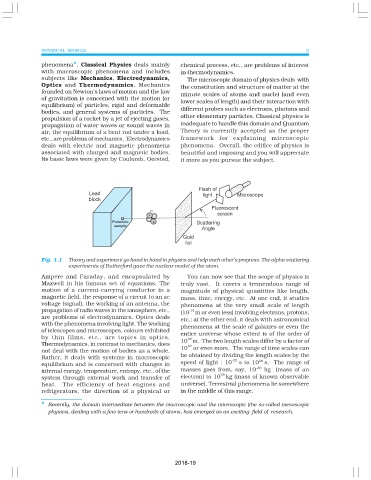
                Fig. 1.1  Theory and experiment go hand in hand in physics and help each other’s progress. The alpha scattering
                         experiments of Rutherford gave the nuclear model of the atom.
                Ampere and Faraday, and encapsulated by            You can now see that the scope of physics is
                Maxwell in his famous set of equations. The      truly vast.  It covers a tremendous range of
                motion of a current-carrying conductor in a      magnitude of physical quantities like length,
                magnetic field, the response of a circuit to an ac  mass, time, energy, etc.  At one end, it studies
                voltage (signal), the working of an antenna, the  phenomena at the very small scale of length
                propagation of radio waves in the ionosphere, etc.,  -14
                                                                 (10  m or even less) involving electrons, protons,
                are problems of electrodynamics. Optics deals
                                                                 etc.; at the other end, it deals with astronomical
                with the phenomena involving light. The working
                                                                 phenomena at the scale of galaxies or even the
                of telescopes and microscopes, colours exhibited  entire universe whose extent is of the order of
                by thin films, etc., are topics in optics.         26
                Thermodynamics, in contrast to mechanics, does   10 m.  The two length scales differ by a factor of
                                                                   40
                not deal with the motion of bodies as a whole.   10  or even more.  The range of time scales can
                Rather, it deals with systems in macroscopic     be obtained by dividing the length scales by the
                                                                                   –22
                                                                                             18
                equilibrium and is concerned with changes in     speed of light : 10  s to 10 s.  The range of
                                                                                            –30
                internal energy, temperature, entropy, etc., of the  masses goes from,  say,  10  kg  (mass of an
                                                                               55
                system through external work and transfer of     electron) to 10 kg (mass of known observable
                heat.  The efficiency of heat engines and        universe). Terrestrial phenomena lie somewhere
                refrigerators, the direction of a physical or    in the middle of this range.
                * Recently, the domain intermediate between the macroscopic and the microscopic (the so-called mesoscopic
                  physics), dealing with a few tens or hundreds of atoms, has emerged as an exciting  field of  research.


                                                               2018-19

