


Page 21 - Class-11-Physics-Part-1_Neat
P. 21
PHYSICAL WORLD                                                                               7

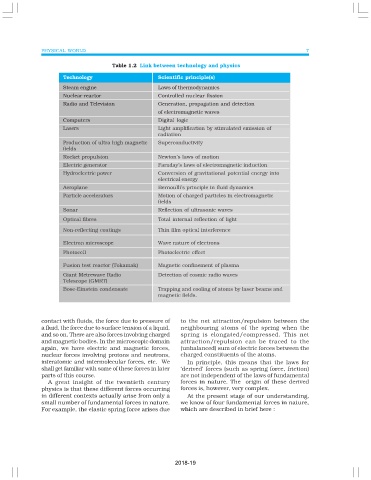
                                         Table 1.2  Link between technology and physics

                       Technology                        Scientific principle(s)
                       Steam engine                      Laws of thermodynamics
                       Nuclear reactor                   Controlled nuclear fission
                       Radio and Television              Generation, propagation and detection
                                                         of electromagnetic waves
                       Computers                         Digital logic
                       Lasers                            Light amplification by stimulated emission of
                                                         radiation
                       Production of ultra high magnetic  Superconductivity
                       fields
                       Rocket propulsion                 Newton’s laws of motion
                       Electric generator                Faraday’s laws of electromagnetic induction
                       Hydroelectric power               Conversion of gravitational potential energy into
                                                         electrical energy
                       Aeroplane                         Bernoulli’s principle in fluid dynamics
                       Particle accelerators             Motion of charged particles in electromagnetic
                                                         fields
                       Sonar                             Reflection of ultrasonic waves
                       Optical fibres                    Total internal reflection of light
                       Non-reflecting coatings           Thin film optical interference

                       Electron microscope               Wave nature of electrons
                       Photocell                         Photoelectric effect

                       Fusion test reactor (Tokamak)     Magnetic confinement of plasma
                       Giant Metrewave Radio             Detection of cosmic radio waves
                       Telescope (GMRT)
                       Bose-Einstein condensate          Trapping and cooling of atoms by laser beams and
                                                         magnetic fields.


                contact with fluids, the force due to pressure of  to the net attraction/repulsion between the
                a fluid, the force due to surface tension of a liquid,  neighbouring  atoms of the spring when the
                and so on. There are also forces involving charged  spring is elongated/compressed. This net
                and magnetic bodies. In the microscopic domain   attraction/repulsion can be traced to the
                again, we have electric and magnetic forces,     (unbalanced) sum of electric forces between the
                nuclear forces involving protons and neutrons,   charged constituents of the atoms.
                interatomic and intermolecular forces, etc.  We    In principle, this means that the laws for
                shall get familiar with some of these forces in later  ‘derived’ forces (such as spring force, friction)
                parts of this course.                            are not independent of the laws of fundamental
                  A great insight of the twentieth century       forces in nature. The  origin of these derived
                physics is that these different forces occurring  forces is, however, very complex.
                in different contexts actually arise from only a   At the present stage of our understanding,
                small number of fundamental forces in nature.    we know of four fundamental forces in nature,
                For example, the elastic spring force arises due  which are described in brief here :


                                                               2018-19

