


Page 19 - Class-11-Physics-Part-1_Neat
P. 19
PHYSICAL WORLD                                                                               5

                theory of objects falling to the earth under     A most significant area to which physics has
                gravity.                                         and will contribute is the development of
                                                                 alternative energy resources.  The fossil fuels of
                1.3  PHYSICS, TECHNOLOGY AND SOCIETY
                                                                 the planet are dwindling fast and there is an
                The connection between physics, technology       urgent need to discover new and affordable
                and society can be seen in many examples. The    sources of energy.  Considerable progress has
                discipline of thermodynamics arose from the      already been made in this direction (for
                need to understand and improve the working of    example, in conversion of solar energy,
                heat engines.  The steam engine, as we know,     geothermal energy, etc., into electricity), but
                is inseparable from the Industrial Revolution in  much more is still to be accomplished.
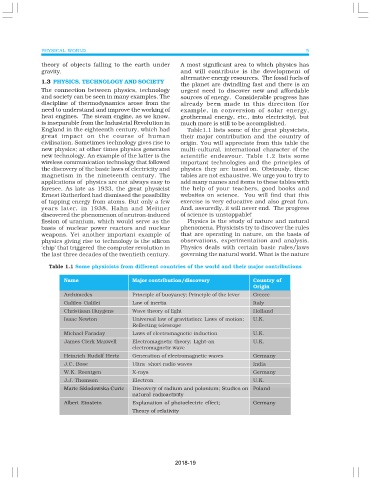
                England in the eighteenth century, which had       Table1.1 lists some of the great physicists,
                great impact on the course of human              their major contribution and the country of
                civilisation. Sometimes technology gives rise to  origin. You will appreciate from this table the
                new physics; at other times physics generates    multi-cultural, international character of the
                new technology. An example of the latter is the  scientific endeavour. Table 1.2 lists some
                wireless communication technology that followed  important technologies and the principles of
                the discovery of the basic laws of electricity and  physics  they  are  based on.  Obviously,  these
                magnetism in the nineteenth century. The         tables are not exhaustive. We urge you to try to
                applications of  physics are not always easy to  add many names and items to these tables with
                foresee. As late as 1933, the great physicist    the help of your teachers, good books and
                Ernest Rutherford had dismissed the possibility  websites on science.   You will find that this
                of tapping energy from atoms. But only a few     exercise is very educative and also great fun.
                years later, in 1938, Hahn and Meitner           And, assuredly, it will never end.  The progress
                discovered the phenomenon of neutron-induced     of science is unstoppable!
                fission of uranium, which would serve as the       Physics is the study of nature and natural
                basis of nuclear power reactors and nuclear      phenomena. Physicists try to discover the rules
                weapons. Yet another important example of        that are operating in nature, on the basis of
                physics giving rise to technology is the silicon  observations, experimentation and analysis.
                ‘chip’ that triggered  the computer revolution in  Physics deals with certain basic rules/laws
                the last three decades of the twentieth century.  governing the natural world. What is the nature
                  Table 1.1 Some physicists from different countries of the world and their major contributions

                        Name                    Major contribution/discovery               Country of
                                                                                           Origin
                        Archimedes              Principle of buoyancy; Principle of the lever  Greece
                        Galileo Galilei         Law of inertia                             Italy
                        Christiaan Huygens      Wave theory of light                       Holland
                        Isaac Newton            Universal law of gravitation; Laws of motion;  U.K.
                                                Reflecting telescope
                        Michael Faraday         Laws of electromagnetic induction          U.K.
                        James Clerk Maxwell     Electromagnetic theory; Light-an           U.K.
                                                electromagnetic wave
                        Heinrich Rudolf Hertz   Generation of electromagnetic waves        Germany
                        J.C. Bose               Ultra  short radio waves                   India
                        W.K. Roentgen           X-rays                                     Germany
                        J.J. Thomson            Electron                                   U.K.
                        Marie Sklodowska Curie  Discovery of radium and polonium; Studies on Poland
                                                natural radioactivity
                        Albert Einstein         Explanation of photoelectric effect;       Germany
                                                Theory of relativity


                                                               2018-19

