


Page 20 - Class-11-Physics-Part-1_Neat
P. 20
6                                                                                      PHYSICS

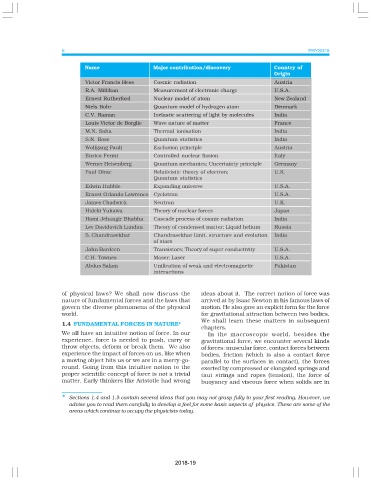
                               Name                    Major contribution/discovery               Country of
                                                                                                  Origin
                               Victor Francis Hess     Cosmic radiation                           Austria
                               R.A. Millikan           Measurement of electronic charge           U.S.A.
                               Ernest Rutherford       Nuclear model of atom                      New Zealand
                               Niels Bohr              Quantum model of hydrogen atom             Denmark
                               C.V. Raman              Inelastic scattering of light by molecules  India
                               Louis Victor de Borglie  Wave nature of matter                     France
                               M.N. Saha               Thermal ionisation                         India
                               S.N. Bose               Quantum statistics                         India
                               Wolfgang Pauli          Exclusion principle                        Austria
                               Enrico Fermi            Controlled nuclear fission                 Italy
                               Werner Heisenberg       Quantum mechanics; Uncertainty principle   Germany
                               Paul Dirac              Relativistic theory of electron;           U.K.
                                                       Quantum statistics
                               Edwin Hubble            Expanding universe                         U.S.A.
                               Ernest Orlando Lawrence  Cyclotron                                 U.S.A.
                               James Chadwick          Neutron                                    U.K.
                               Hideki Yukawa           Theory of nuclear forces                   Japan
                               Homi Jehangir Bhabha    Cascade process of cosmic radiation        India
                               Lev Davidovich Landau   Theory of condensed matter; Liquid helium  Russia
                               S. Chandrasekhar        Chandrasekhar limit, structure and evolution  India
                                                       of stars
                               John Bardeen            Transistors; Theory of super conductivity  U.S.A.
                               C.H. Townes             Maser; Laser                               U.S.A.
                               Abdus Salam             Unification of weak and electromagnetic    Pakistan
                                                       interactions


                       of physical laws? We shall now discuss the       ideas about it.  The correct notion of force was
                       nature of fundamental forces and the laws that   arrived at by Isaac Newton in his famous laws of
                       govern the diverse phenomena of the physical     motion. He also gave an explicit form for the force
                       world.                                           for gravitational attraction between two bodies.
                                                                        We shall learn these matters in subsequent
                       1.4  FUNDAMENTAL FORCES IN NATURE*
                                                                        chapters.
                       We all have an intuitive notion of force. In our    In the macroscopic world, besides the
                       experience, force is needed to push, carry or    gravitational force, we encounter several kinds
                       throw objects, deform or break them.  We also    of forces: muscular force, contact forces between
                       experience the impact of forces on us, like when  bodies, friction (which is also a contact force
                       a moving object hits us or we are in a merry-go-  parallel to the surfaces in contact), the forces
                       round. Going from this intuitive notion to the   exerted by compressed or elongated springs and
                       proper scientific concept of force is not a trivial  taut strings and ropes (tension), the force of
                       matter. Early thinkers like Aristotle had wrong  buoyancy and viscous force when solids are in

                       * Sections 1.4 and 1.5 contain several ideas that you may not grasp fully in your first reading. However, we
                         advise you to read them carefully to develop a feel for some basic aspects of  physics. These are some of the
                         areas which continue to occupy the physicists today.


                                                               2018-19

