


Page 191 - Class-11-Physics-Part-1_Neat
P. 191
SYSTEMS OF PARTICLES AND ROTATIONAL MOTION                                                 177


                       15. Rotation about a fixed axis is directly analogous to linear motion in respect of kinematics
                           and dynamics.
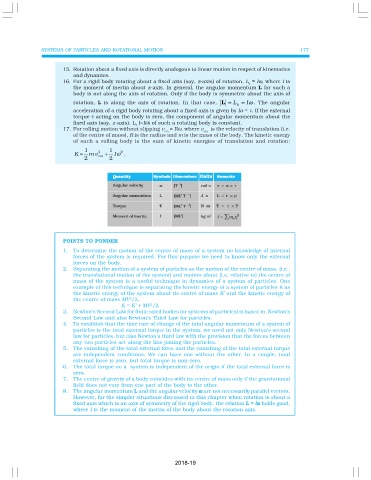
                       16. For a rigid body rotating about a fixed axis (say, z-axis) of rotation, L  = Iω, where I is
                                                                                         z
                           the moment of inertia about z-axis. In general, the angular momentum L for such a
                           body is not along the axis of rotation. Only if the body is symmetric about the axis of
                           rotation, L  is along the axis of rotation. In that case, L  =  L =  Iω . The angular
                                                                                     z
                           acceleration of a rigid body rotating about a fixed axis is given by Iα = τ. If the external
                           torque τ acting on the body is zero, the component of angular momentum about the
                           fixed axis (say, z-axis), L  (=Iω) of such a rotating body is constant.
                                                 z
                       17. For rolling motion without slipping v  = Rω, where v   is the velocity of translation (i.e.
                                                           cm            cm
                           of the centre of mass), R is the radius and m is the mass of the body. The kinetic energy
                           of such a rolling body is the sum of kinetic energies of translation and rotation:
                               1        1
                           K =  m v  2  +  Iω .
                                            2
                               2    cm  2


                       POINTS TO PONDER
                       1.  To determine the motion of the centre of mass of a system no knowledge of internal
                           forces of the system is required. For this purpose we need to know only the external
                           forces on the body.
                       2.  Separating the motion of a system of particles as the motion of the centre of mass, (i.e.,
                           the translational motion of the system) and motion about (i.e. relative to) the centre of
                           mass of the system is a useful technique in dynamics of a system of particles. One
                           example of this technique is separating the kinetic energy of a system of particles K as
                           the kinetic energy of the system about its centre of mass K′ and the kinetic energy of
                                               2
                           the centre of mass MV /2,
                                              K = K′ + MV /2
                                                      2
                       3.  Newton’s Second Law for finite sized bodies (or systems of particles) is based in  Newton’s
                           Second Law and also Newton’s Third Law for particles.
                       4.  To establish that the time rate of change of the total angular momentum of a system of
                           particles is the total external torque in the system, we need not only Newton’s second
                           law for particles, but also Newton’s third law with the provision that the forces between
                           any two particles act along the line joining the particles.
                       5.  The vanishing of the total external force and the vanishing of the total external torque
                           are independent conditions. We can have one without the other. In a couple, total
                           external force is zero, but total torque is non-zero.
                       6.  The total torque on a  system is independent of the origin if the total external force is
                           zero.
                       7.  The centre of gravity of a body coincides with its centre of mass only if the gravitational
                           field does not vary from one part of the body to the other.
                       8.  The angular momentum L and the angular velocity ωω ωω ω are not necessarily parallel vectors.
                           However, for the simpler situations discussed in this chapter when rotation is about a
                           fixed axis which is an axis of symmetry of the rigid body, the relation L = Iωω ωω ω holds good,
                           where I is the moment of the inertia of the body about the rotation axis.


                                                               2018-19

