


Page 195 - Class-11-Physics-Part-1_Neat
P. 195
SYSTEMS OF PARTICLES AND ROTATIONAL MOTION                                                 181

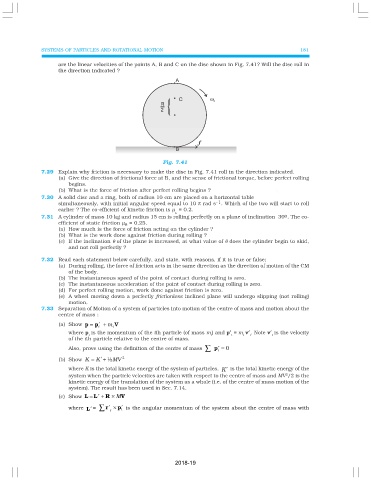
                      are the linear velocities of the points A, B and C on the disc shown in Fig. 7.41? Will the disc roll in
                      the direction indicated ?


                                                           Fig. 7.41

                7.29 Explain why friction is necessary to make the disc in Fig. 7.41 roll in the direction indicated.
                      (a) Give the direction of frictional force at B, and the sense of frictional torque, before perfect rolling
                         begins.
                      (b) What is the force of friction after perfect rolling begins ?
                7.30 A solid disc and a ring, both of radius 10 cm are placed on a horizontal table
                      simultaneously, with initial angular speed equal to 10 π rad s -1 . Which of the two will start to roll
                      earlier ? The co-efficient of kinetic friction is µ  = 0.2.
                                                               k
                7.31 A cylinder of mass 10 kg and radius 15 cm is rolling perfectly on a plane of inclination  30 o . The co-
                      efficient of static friction µ  = 0.25.
                                             s
                      (a) How much is the force of friction acting on the cylinder ?
                      (b) What is the work done against friction during rolling ?
                      (c) If the inclination θ of the plane is increased, at what value of θ does the cylinder begin to skid,
                         and not roll perfectly ?

                7.32 Read each statement below carefully, and state, with reasons, if it is true or false;
                      (a) During rolling, the force of friction acts in the same direction as the direction of motion of the CM
                         of the body.
                      (b) The instantaneous speed of the point of contact during rolling is zero.
                      (c) The instantaneous acceleration of the point of contact during rolling is zero.
                      (d) For perfect rolling motion, work done against friction is zero.
                      (e) A wheel moving down a perfectly frictionless  inclined plane will undergo slipping (not rolling)
                         motion.
                7.33 Separation of Motion of a system of particles into motion of the centre of mass and motion about the
                      centre of mass :
                      (a) Show  p =  p′ + m  V
                                    i    i
                         where p  is the momentum of the ith particle (of mass m ) and p′′ ′′ ′  = m  v′′ ′′ ′ . Note v′′ ′′ ′  is the velocity
                                i                                           i      i   i  i      i
                         of the ith particle relative to the centre of mass.
                         Also, prove using the definition of the centre of mass  ∑  p ′ = 0
                                                                              i
                      (b) Show  K =  K′+  ½MV  2
                         where K is the total kinetic energy of the system of particles,  K′  is the total kinetic energy of the
                                                                                                      2
                         system when the particle velocities are taken with respect to the centre of mass and MV /2 is the
                         kinetic energy of the translation of the system as a whole (i.e. of the centre of mass motion of the
                         system). The result has been used in Sec. 7.14.
                      (c) Show L L= ′ +  R × M V

                                           p
                         where   ′ L  =  ∑ r ′ × ′  is the angular momentum of the system about the centre of mass with
                                            i
                                        i


                                                               2018-19

