Page 189 - Class-11-Physics-Part-1_Neat
P. 189
SYSTEMS OF PARTICLES AND ROTATIONAL MOTION                                                 175

                   Equation (7.49b) applies to any rolling body:
                                                                                      2
                                                                           1        k 
                a disc, a cylinder, a ring or a sphere.              mgh =   mυ  1+  2 
                                                                                2
                                                                           2        R  
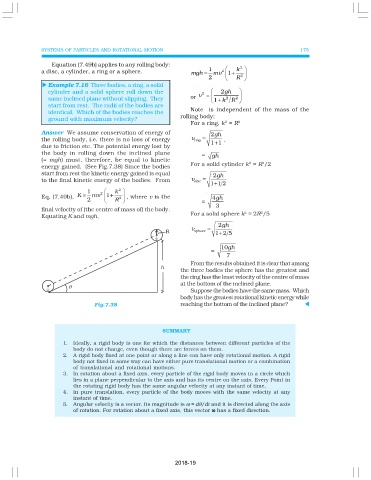
                u Example 7.16  Three bodies, a ring, a solid
                  cylinder and a solid sphere roll down the            υ =    2gh   
                                                                         2
                  same inclined plane without slipping.  They       or       1 k  2  R 2  
                                                                              +
                  start from rest.  The radii of the bodies are
                  identical.  Which of the bodies reaches the       Note   is independent of the mass of the
                  ground with maximum velocity?                  rolling body;
                                                                    For a ring, k  = R 2
                                                                                 2
                Answer  We assume conservation of energy of                 2gh
                the rolling body, i.e. there is no loss of energy    υ ring  =  ,
                                                                             +
                                                                            1 1
                due to friction etc. The potential energy lost by
                the body in rolling down the inclined plane
                                                                          =  gh
                (= mgh) must, therefore, be equal to kinetic
                                                                                         2
                                                                    For a solid cylinder k  = R /2
                                                                                              2
                energy gained.  (See Fig.7.38) Since the bodies
                start from rest the kinetic energy gained is equal           2gh
                to the final kinetic energy of the bodies.  From     υ disc  =
                                                                             +
                                                                            1 1 2
                                           2
                                1    2    k 
                Eq. (7.49b),   K =  mυ  1+  2  , where v is the           4gh
                                2        R                              =
                                                                             3
                final velocity of (the centre of mass of) the body.                     2    2
                Equating K and mgh,                                 For a solid sphere k  = 2R /5
                                                                              2gh
                                                                     υ    =
                                                                               +
                                                                      sphere
                                                                             1 2 5
                                                                               10gh
                                                                              =
                                                                                 7
                                                                    From the results obtained it is clear that among
                                                                 the three bodies the sphere has the greatest and
                                                                 the ring has the least velocity of the centre of mass
                                                                 at the bottom of the inclined plane.
                                                                    Suppose the bodies have the same mass.  Which
                                                                 body has the greatest rotational kinetic energy while
                                   Fig.7.38                      reaching the bottom of the inclined plane?  t


                                                           SUMMARY
                       1.  Ideally, a rigid body is one for which the distances between different particles of the
                           body do not change, even though there are forces on them.
                       2.  A rigid body fixed at one point or along a line can have only rotational motion. A rigid
                           body not fixed in some way can have either pure translational motion or a combination
                           of translational and rotational motions.
                       3.  In rotation about a fixed axis, every particle of the rigid body moves in a circle which
                           lies in a plane perpendicular to the axis and has its centre on the axis. Every Point in
                           the rotating rigid body has the same angular velocity at any instant of time.
                       4.  In pure translation, every particle of the body moves with the same velocity at any
                           instant of time.
                       5.  Angular velocity is a vector. Its magnitude is ω = dθ/dt and it is directed along the axis
                           of rotation. For rotation about a fixed axis, this vector ωω ωω ω has a fixed direction.


                                                               2018-19
   184   185   186   187   188   189   190   191   192   193   194