


Page 188 - Class-11-Physics-Part-1_Neat
P. 188
174                                                                                    PHYSICS

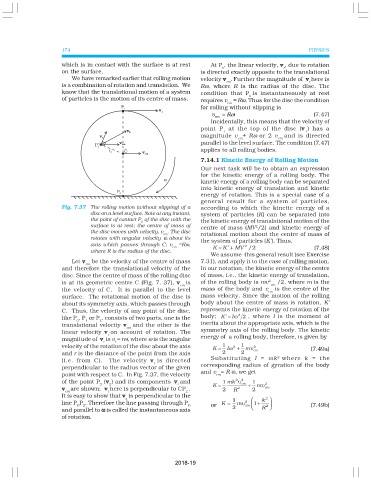
                       which is in contact with the surface is at rest      At P , the linear velocity, v , due to rotation
                                                                                o                    r
                       on the surface.                                  is directed exactly opposite to the translational
                          We have remarked earlier that rolling motion  velocity v . Further the magnitude of  v here is
                                                                                 cm
                                                                                                              r
                       is a combination of rotation and translation.  We  Rω, where R  is the radius of the disc. The
                       know that the translational motion of a system   condition that P is instantaneously at rest
                                                                                         o
                       of particles is the motion of its centre of mass.  requires v  = Rω. Thus for the disc the condition
                                                                                 cm
                                                                        for rolling without slipping is
                                                                            υ   =  R ω                          (7.47)
                                                                             cm
                                                                            Incidentally, this means that the velocity of
                                                                        point P   at the top of the disc (v ) has a
                                                                                1                            1
                                                                        magnitude v + Rω or 2 v       and is directed
                                                                                     cm            cm
                                                                        parallel to the level surface. The condition (7.47)
                                                                        applies to all rolling bodies.
                                                                        7.14.1 Kinetic Energy of Rolling Motion
                                                                        Our next task will be to obtain an expression
                                                                        for the kinetic energy of a rolling body. The
                                                                        kinetic energy of a rolling body can be separated
                                                                        into kinetic energy of translation and kinetic
                                                                        energy of rotation. This is a special case of a
                                                                        general result for a system of particles,
                       Fig. 7.37 The rolling motion (without slipping) of a  according to which the kinetic energy of a
                                 disc on a level surface. Note at any instant,  system of particles (K) can be separated into
                                 the point of contact P  of the disc with the
                                                   0                    the kinetic energy of translational motion of the
                                 surface is at rest; the centre of mass of  centre of mass (MV /2) and kinetic energy of
                                                                                            2
                                 the disc moves with velocity, v . The disc
                                                           cm           rotational motion about the centre of mass of
                                 rotates with angular velocity  ω about its  the system of particles (K′). Thus,
                                 axis which passes through C; v  =Rω,
                                                              cm                                                (7.48)
                                 where R is the radius of the disc.
                                                                            We assume  this general result (see Exercise
                          Let v  be the velocity of the centre of mass  7.31), and apply it to the case of rolling motion.
                               cm
                       and therefore the translational velocity of the  In our notation, the kinetic energy of the centre
                       disc. Since the centre of mass of the rolling disc  of mass, i.e., the kinetic energy of translation,
                       is at its geometric centre C (Fig. 7. 37), v  is  of the rolling body is mv 2   /2, where m is the
                                                                 cm                              cm
                       the velocity of C.  It is parallel to the level  mass of the body and v  is the centre of the
                                                                                                cm
                       surface.  The rotational motion of the disc is   mass velocity. Since the motion of the rolling
                       about its symmetry axis, which passes through    body about the centre of mass is rotation, K′
                       C.  Thus, the velocity of any point of the disc,  represents the kinetic energy of rotation of the
                       like P , P  or P , consists of two parts, one is the  body;       , where I  is the moment of
                            0  1    2
                       translational velocity v  and the other is the   inertia about the appropriate axis, which is the
                                              cm
                       linear velocity v on account of rotation. The    symmetry axis of the rolling body. The kinetic
                                       r
                       magnitude of  v  is v = rω, where ω is the angular  energy of  a rolling body, therefore, is given by
                                      r   r
                       velocity of the rotation of the disc about the axis
                                                                                                               (7.49a)
                       and r is the distance of the point from the axis                            2
                       (i.e. from C).   The velocity v is directed          Substituting I   = mk where k       = the
                                                        r
                       perpendicular to the radius vector of the given  corresponding radius of gyration of the body
                                                                        and v = R ω, we get
                       point with respect to C.  In Fig. 7.37, the velocity   cm
                       of the point P  (v ) and its components  v and
                                    2   2                        r
                       v are shown;  v here is perpendicular to CP .
                        cm             r                           2
                       It is easy to show that v  is perpendicular to the
                                             z
                       line P P . Therefore the line passing through P
                            O  2                                    O       or                                 (7.49b)
                       and parallel to ωω ωω ω is called the instantaneous axis
                       of rotation.


                                                               2018-19

